 How-to
What Is Print on Demand Quality? A Buyer's Guide
Quick Summary
Print on demand quality is the combined result of fabric, print method, and finishing that determines how a shirt feels and looks after the first wash. Good quality depends on fabric weight, fabric content, construction, and how well the print is cured. You can judge it before buying by inspecting the sample and running a simple wash test.
- Check fabric weight, since a low price often means a lighter blank than expected.
- Match the print method to the fabric: DTG suits cotton, sublimation suits polyester.
- Inspect print edges and colors under daylight and compare them to your design file.
- Run three to five wash-and-wear cycles to reveal fading, cracking, and peeling.
- Use cold water and low heat in the dryer, since high heat is the most common cause of print damage.
Table of Contents
- What Print on Demand Quality Actually Means
- How the Print-on-Demand Process Shapes the Final Shirt
- Print-on-Demand Printing Methods and Their Trade-Offs
- Print-on-Demand Shirt Quality: The Factors That Matter
- How to Test Print-on-Demand Products Before You Buy
- Wash Tests, Durability, and Troubleshooting Defects
- Choosing a Shirt You Can Trust in 2026
- Frequently Asked Questions
What Is Print on Demand Quality? A Buyer's Guide
Last Updated: October 28, 2026
Print on demand quality is the mix of fabric, print method, and finishing that decides how a shirt feels and looks after the first wash. This guide shows you how to judge quality before you buy. Use code mild20 for 20% off your first order.
What Print on Demand Quality Actually Means
Quality in print on demand covers more than the picture on the front. A shirt is printed only after an order comes in, so the blank garment, the ink, and the press all matter.
Most buyers care about three things: how the fabric feels, how the print looks, and how well both hold up over time. A tee can score well on one and fail on another.
Watch out: a low price often means a heavier or thinner blank than you expected. Check the fabric weight before you assume two shirts are alike.
How the Print-on-Demand Process Shapes the Final Shirt
Each order is printed fresh, so the process itself affects quality.
Small steps add up. Uneven curing can leave a print that feels stiff or peels early. Poor color calibration can make a design look different from the mockup.
Print-on-Demand Printing Methods and Their Trade-Offs
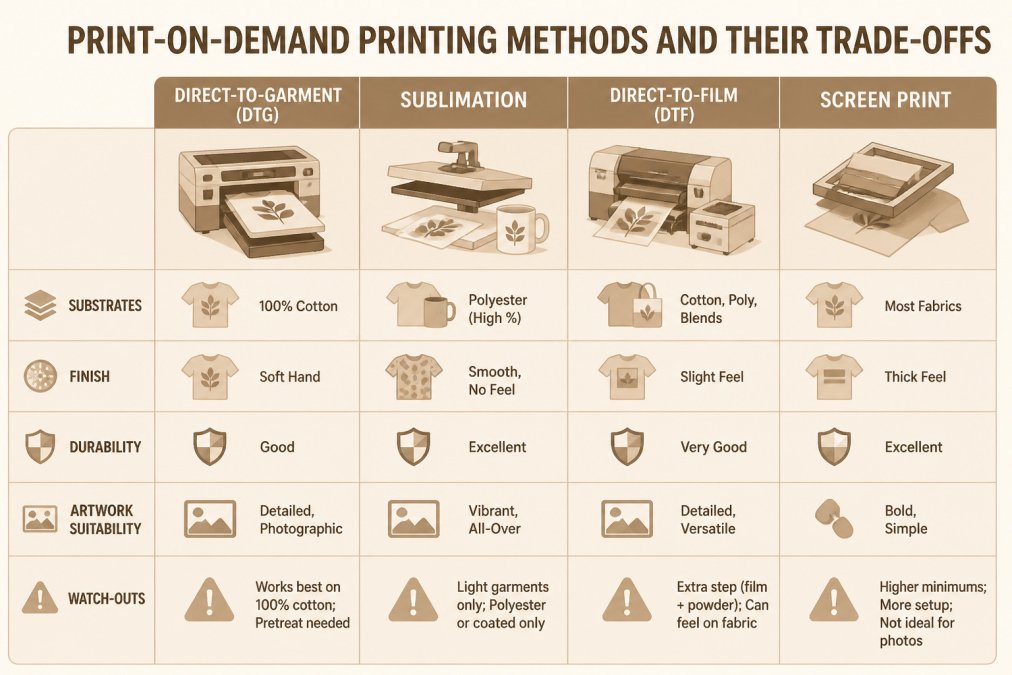
The print method sets the feel, finish, and durability of the design, and it also constrains which blanks and artwork will actually work. Four methods dominate print-on-demand fulfillment, and each behaves differently on cotton, polyester, and blends.
| Method | Best Substrates | Finish | Durability | Artwork That Suits It | Watch-Outs |
|---|---|---|---|---|---|
| Direct-to-garment (DTG) | 100% cotton and high-cotton blends | Soft, matte, sinks into fibers | Good when cured properly; can fade on dark poly | Detailed, full-color, photographic, gradients | Pretreatment variance; white ink on dark shirts can feel heavier |
| Sublimation | Polyester and poly-rich blends, plus hard goods with a coating | Smooth, edge-to-edge, no hand feel | Excellent on poly; poor on cotton | All-over prints, vivid color, photo reproduction | Will not bond to 100% cotton; colors can look muted on uncoated surfaces |
| Direct-to-film (DTF) | Cotton, poly, blends, and some hard goods | Slightly raised, flexible film | Good; depends on film and press settings | Bold graphics, small text, multi-color designs | Can feel plasticky if over-pressed; edges may lift after repeated washes |
| Screen print | Cotton and cotton blends | Ink sits on top; thicker hand | Very good on simple designs | Bold, simple, limited-color artwork | Setup cost favors larger runs; gradients and fine detail are hard |
Print-on-Demand Shirt Quality: The Factors That Matter
Four factors shape how a shirt performs day to day:
Take the Scenic Route Graphic Tee – Outdoorsy Road Trip Unisex T-Shirt →
- Fabric weight: Heavier cotton feels sturdier. Lighter cotton drapes softly.
- Fabric content: Ringspun cotton tends to feel smoother. Heather colors often blend in polyester.
- Construction: Tubular bodies and double-stitched hems hold their shape longer.
- Print curing: A properly cured print stays flexible and resists cracking.
Look for these details on product pages. If a listing skips fabric weight or construction, ask the seller before you buy.
How to Test Print-on-Demand Products Before You Buy
You can't feel a shirt through a screen, but you can check it with a simple routine.
- Inspect the print under daylight for color match and edge sharpness.
- Stretch the collar and sleeve to check recovery.
- Run the shirt through a cold wash, inside out, and air dry it.
- Compare the feel and print after the wash to the first look.
What to Check in a Print-on-Demand Sample
- Print edges are crisp, with no fuzzy halos
- Colors match your design file closely
- Collar keeps its shape after stretching
- Fabric feels soft without feeling thin
- Print stays flexible, not stiff or cracked
Wash Tests, Durability, and Troubleshooting Defects
A first look tells you how a print looks; a wash test tells you how it will live. Most practitioners find that three to five wash-and-wear cycles reveal the defects that matter: fading, cracking, peeling, shrinkage, and color transfer. Run the same protocol on every sample so results are comparable.
A Simple Wash-and-Wear Test Protocol
- Baseline photo. Photograph the print and fabric in daylight before washing, and note the fabric weight and measurements.
- Cold wash, inside out. Machine wash on cold with a mild detergent and no fabric softener. Fabric softener can leave a residue that masks print feel.
- Air dry the first cycle. Air drying isolates print durability from dryer heat.
- Tumble dry low on later cycles. Add low heat on cycles two through five to test real-world care.
- Re-photograph and compare. Check the same angles and lighting as the baseline.
What to Judge After Each Cycle
- Fading: Compare the print color to the baseline photo under the same light. A slight softening is normal; a visible shift toward gray or washed-out tones is a defect.
- Cracking: Flex the print gently. Hairline cracks at the edges are early warning signs; cracks across the design are a fail.
- Peeling: Lift a corner of the print with a fingernail. Any lifting beyond the very edge suggests poor adhesion or under-curing.
- Shrinkage: Measure the chest and body length against the baseline. Most cotton blanks shrink modestly on the first wash; a second large drop signals a construction problem.
- Color transfer: Wash the sample with a white cotton cloth and check whether dye bleeds onto the cloth.
Troubleshooting Defects and Resolving Supplier Issues
- Document the defect. Take daylight photos of the full item, a close-up of the defect, and the care label. Note the order number, product variant, and the wash cycle where the issue appeared.
- Set an acceptable threshold. A common pattern is to treat a single small print flaw on a low-visibility area as a minor issue and a crack, peel, or color shift across the design as a replacement case. Decide your threshold before you order so you are not negotiating with yourself later.
- Request a replacement or refund. Most reputable providers replace defective items when you supply photos and order details. Ask whether they want the item returned or discarded; many do not require a return for low-value defects.
- Prevent recurrence. If the same defect shows up across samples, ask the provider whether the cause is pretreatment, cure temperature, or a blank change. A provider who cannot explain the cause is unlikely to fix it.
Choosing a Shirt You Can Trust in 2026
Trust comes from clear product details and a seller who stands behind the shirt. Look for listed fabric weight, print method, care instructions, and a real support email.
Our approach at Mild Statement LLC is simple: every tee is printed on demand, ships free within the US, and comes with a clear support path if something is off. You can explore the full range at mildstatement.com.
Frequently Asked Questions
What does print-on-demand quality mean?
Print-on-demand quality describes how a shirt looks and feels. Because each item is printed only after an order arrives, quality depends on the printing method and the blank garment.
How can you tell if a print-on-demand shirt is good quality?
Check the product listing for fabric weight, care instructions, and fit notes.
How do you test print-on-demand products before selling them?
Order a sample of each product you plan to sell, then test it the way a customer will use it. Compare the print against your design file at the same size, check color accuracy in natural light, and inspect placement and alignment. Wash the shirt inside out in cold water, tumble dry on low, and check for fading, cracking, or fabric pilling after several cycles. Record your results in a simple scorecard so you can compare providers and product variants fairly.
What should you check in a print-on-demand sample?
Check print sharpness on fine lines and small text, color match against your digital file, and whether the print is centered and straight. Feel the hand of the fabric and confirm the fit matches the size chart. Look at the stitching at the neck and hems, and note any ink bleed, gaps, or uneven coverage. If something looks off on the sample, it will likely appear on every order, so request a fix from the provider before you list the product.
Ready to try one? Take the Scenic Route Graphic Tee gives you a soft, relaxed fit for everyday wear, and it's a good first sample to test with the routine above.