 How-to
How Print on Demand Reduces Textile Waste
Quick Summary
Print on demand reduces textile waste because garments are printed only after a customer orders them, so no unsold bulk stock is made and later discarded. Traditional brands produce large batches to lower unit costs, and leftover stock often ends up in clearance bins, donation centers, or landfill. Made-to-order production removes most of that path.
- Bulk manufacturing produces hundreds or thousands of units before knowing demand, leaving unsold stock.
- Print on demand makes one unit per order, after the sale is confirmed.
- Unsold garments often end up in clearance bins, donation centers, or landfill.
- Returns and reprints can erode the waste savings, so sizing guidance matters.
- Blank garments are still produced in advance, so forecast blank demand separately.
Table of Contents
- How Print on Demand Reduces Textile Waste
- Why Fashion Overproduction and Textile Waste Keep Growing
- How Made-to-Order Production Works, Step by Step
- Traditional Bulk Manufacturing vs. Print on Demand
- Made-to-Order Clothing Environmental Impact: What the Numbers Show
- Digital Textile Printing Environmental Impact and Its Trade-Offs
- When Print on Demand Does Not Reduce Total Waste
- Checking a Brand's Sustainability Claims Before You Buy
- Frequently Asked Questions
How Print on Demand Reduces Textile Waste
Last Updated: November 21, 2026
Most clothing waste starts before a single shirt is sold. Brands guess how many units customers will want, print or cut far more than they can sell, and then face piles of unsold stock. Mild Statement LLC prints its tees on demand, so the model described here applies to its own products. Here is how that model works, where it helps, and where it does not.
Print on demand is a production model where a garment is made only after a customer places an order. Instead of guessing demand and manufacturing in bulk, the seller prints one item at a time, which is why it is often called made-to-order production.
Why Fashion Overproduction and Textile Waste Keep Growing
Overproduction happens when more clothing gets made than people buy. Traditional brands order large batches to get lower unit costs, then discount or destroy what does not sell. That leftover stock is often called deadstock.
Excess inventory is the main driver of this waste. Each unsold garment carries the water, energy, and fabric used to make it, even if it never gets worn. A common approach is to forecast demand months in advance, which means small guesses about trends can turn into large piles of stock.
How Made-to-Order Production Works, Step by Step
Made-to-order production follows a simple sequence. Each step only happens after the one before it is complete.
- A customer places an order. Demand is known before any fabric is touched.
- The design is printed on a blank. Only the garment that was ordered gets printed.
- The item is packed and shipped. It goes straight to the buyer, skipping the warehouse.
- Leftover materials stay small. Without bulk runs, there are fewer offcuts and fewer unsold blanks.
Because each step depends on a real order, the process cuts down on the guesswork that drives overproduction.
Where Unsold Garments and Deadstock Usually End Up
When bulk stock does not sell, it often goes to clearance bins, donation centers, or landfill. Some of it is shredded or sent overseas, where it may never be worn again. Textile waste that reaches landfills breaks down slowly and releases methane as it decomposes.
Print on demand avoids most of this path. If there is no stock to clear, there is nothing to dump.
Traditional Bulk Manufacturing vs. Print on Demand
The two models differ mainly in when production happens.
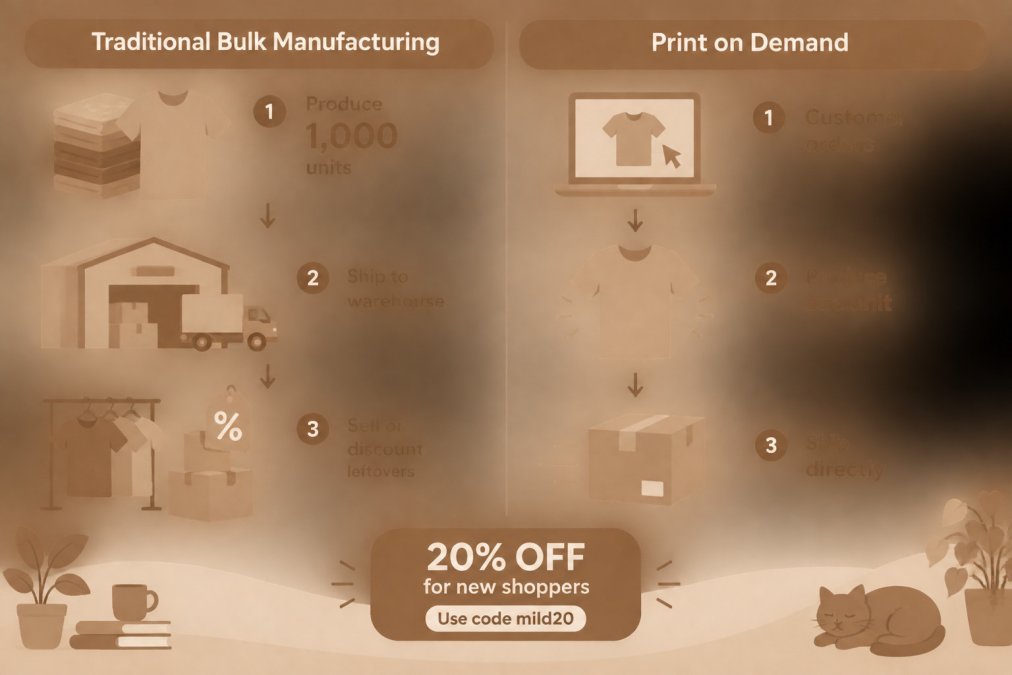
- Bulk manufacturing: The brand produces hundreds or thousands of units up front, then hopes they sell.
- Print on demand: The brand produces one unit per order, after the sale.
- Bulk risk: Unsold stock becomes a loss.
- Print on demand risk: Lower margins per item and longer shipping times.
Bulk manufacturing can work for proven best sellers. Print on demand works better for designs that are new, niche, or hard to predict.
Made-to-Order Clothing Environmental Impact: What the Numbers Show
The environmental case for print on demand rests mostly on avoiding waste, but a credible answer has to walk the full product lifecycle rather than stop at the printing step. The clearest way to read the evidence is stage by stage, and to separate what is well established from what depends on the operator.
Materials and blanks. In a made-to-order model, the blank garment is usually pre-produced by a supplier and printed after the order arrives. That means the fiber, yarn, and fabric stages still carry the water, energy, and chemical load of conventional textile production. Print on demand reduces waste by not producing finished, printed goods that go unsold, it does not eliminate the upstream impact of the blank itself. The choice of blank matters as much as the printing method.
Printing. Digital printing suits one-off production because it skips the screens and setup runs that analog printing needs for each color. The trade-off is that ink chemistry, pre-treatment, and fabric compatibility vary by printer and substrate, so the printing stage is not automatically low-impact.
Packaging and shipping. This is where made-to-order models often lose ground. Single-item shipping uses more packaging and transport per garment than consolidated bulk shipments, and the effect grows when production and fulfillment are far from the customer. A fair comparison counts these costs alongside the savings from avoided overstock.
Returns and end-of-life. Returns, misprints, and quality-control failures can add a second production and shipping cycle. At end of life, fiber composition and garment durability determine whether an item is repaired, reused, recycled, or landfilled.
Reading the numbers honestly. Published figures for water, energy, and emissions vary widely because they depend on the blank, the printer, the shipping distance, and the assumed return rate. Read the full sustainability analysis of print-on-demand clothing. A common pattern is that the waste-avoidance benefit is largest for low-volume, hard-to-forecast designs and smallest for proven best sellers that would have sold through anyway. When you see a comparison, check whether it uses equivalent products and production volumes, and whether it counts returns and single-item shipping. Brands that publish their own lifecycle data, and independent studies that compare the models on the same assumptions, give the clearest answers. See a deeper evidence-based guide to whether print-on-demand clothing is sustainable.
The table below sets out where print on demand changes the environmental picture across each stage of a garment's life.
| Stage | Effect of made-to-order | What to check |
|---|---|---|
| Materials and blanks | Blank still carries fiber, yarn and fabric impact | Choice of blank matters |
| Printing | Digital suits one-off runs, no screen setup | Ink and substrate vary |
| Packaging and shipping | Single-item shipping uses more per garment | Production distance to customer |
| Returns and end-of-life | Returns add a second production cycle | Return rate and fiber composition |
Digital Textile Printing Environmental Impact and Its Trade-Offs
Digital textile printing applies ink directly to fabric, which suits small runs well. Learn how print methods and fabric affect quality before you buy. It avoids the screens that traditional printing needs for each color, so setup waste stays low.
The trade-offs matter, though. Some inks and pre-treatments use chemicals that need careful handling, and print quality depends on the fabric. Washing instructions that protect the print help a garment last longer, which matters as much as how it was made.
When Print on Demand Does Not Reduce Total Waste
Print on demand is not automatically the greener choice. The waste-avoidance benefit is real, but it can shrink or disappear under conditions that are easy to overlook. Understanding those conditions is what separates a credible sustainability claim from a slogan.
Returns and sizing failures. A returned item may be reprinted, reshipped, or discarded depending on the operator's policy. High return rates erode the savings from avoided overstock quickly. Detailed size charts, model measurements, and clear product photos reduce this risk more than any production change.
Defects and quality-control failures. Misprints, crooked placements, and fabric flaws trigger reprints and extra shipping. A quality check before packing catches most of these before they become a second production cycle.
Pre-produced blanks and unsold inventory. Made-to-order printing still depends on blank garments that were produced in advance by a supplier. If a brand over-orders blanks or discontinues a design, those blanks can become deadstock even though the printed item was made to order. Forecasting blank demand and retiring designs cleanly matters.
Single-item shipping and packaging. Shipping one garment at a time uses more packaging and transport per item than consolidated bulk shipments. Production location relative to the customer is a major variable; the same shirt printed and shipped across the country carries a different transport load than one fulfilled nearby.
Low-volume logistics. Very low order volumes can mean less efficient routing and more partial shipments. The effect is small per order but adds up across a catalog.
Materials and end-of-life. A made-to-order shirt that pills, fades, or shrinks after a few washes creates waste through replacement. Fiber composition, print durability, and care instructions determine how long the garment stays in use, which matters as much as how it was produced.
A practical checklist for brands. Forecast blank demand separately from printed demand; keep the catalog tight so discontinued designs do not strand blanks; track return rate, reprint rate, and packaging per order as waste-related KPIs; and give customers sizing guidance that prevents avoidable returns. Without these, the savings from avoided overstock can shrink, and in the worst cases, disappear.
Checking a Brand's Sustainability Claims Before You Buy
Many brands say they are sustainable, so it helps to check the claims yourself. Look for specifics: how the item is made, whether it is printed to order, and what fabric it uses. Vague words like "eco-friendly" do not tell you much.
Mild Statement LLC prints every tee on demand, so nothing goes to waste, and every order ships free. Our Take the Scenic Route tee ($22.50) and Stay Wild Wolf tee ($22.50) are printed to order on a Gildan Softstyle ringspun cotton blank. Use code mild20 for 20% off your first order.
Frequently Asked Questions
How does print on demand reduce textile waste?
Print on demand produces a garment only after a customer places an order, so the factory does not guess how many shirts will sell. Traditional bulk manufacturing prints or cuts large batches in advance, and any units that do not sell become overstock, markdowns, or deadstock. By matching production to actual orders, a print-on-demand brand avoids most of that unsold inventory. Waste is not eliminated entirely, since blanks can still be damaged and returns still happen, but the largest source of excess stock is removed from the process.
Is print-on-demand clothing more sustainable than mass-produced clothing?
In many cases, yes, mainly because it avoids overproduction and unsold stock. However, sustainability depends on more than the production model. Shipping each order separately can add transport emissions, and digital printing uses inks and water that vary by method. Materials, durability, and disposal matter too. A print-on-demand shirt that is worn for years and recycled at end of life can have a lower total impact than a cheap tee that is worn a few times and thrown away. Shoppers should look at the full lifecycle, not just the production method.
Does print on demand eliminate textile waste?
No. Print on demand reduces one major source of waste, unsold inventory, but it does not remove all of it. Defective prints, returned items, and mis-sized garments can still end up discarded. Printers also keep some blank stock on hand, and fabric cutting or printing can leave scraps. Brands that want to reduce waste further can ask their printer about defect rates, how returns are handled, and whether leftover material is reused or recycled.
How can shoppers choose more sustainable printed clothing?
Look for brands that state clearly how their products are made, including whether items are printed on demand and which printing method is used. Be cautious of vague claims like eco-friendly without supporting detail. Check the fabric content and weight, since a heavier, durable cotton tee often lasts longer than a thin one. Ask how returns and defective items are handled. Buying fewer, better-made shirts that you wear often usually does more good than buying many inexpensive ones.