 How-to
How to Keep Graphic Tees From Fading in the Wash
Quick Summary
Keep graphic tees from fading by washing them inside out in cold water on a gentle cycle with a mild detergent, then air-drying them. Heat, friction, and harsh chemicals break down the ink and fabric, so gentler handling protects the print. Avoid hot water, bleach, and high dryer heat for graphic tees.
- Turn the shirt inside out so the print does not rub against the drum.
- Wash in cold water, around 30°C or 86°F.
- Use a small amount of mild detergent and a gentle cycle.
- Air-dry the shirt away from direct sun, or use the lowest dryer heat.
- Skip fabric softener, which can dull prints and weaken the ink bond.
Table of Contents
- Why Graphic Tee Prints Fade in the Wash
- Step-by-Step: How to Wash Graphic Tees Without Cracking
- Choosing the Best Detergent for Graphic Tees
- How to Keep Vinyl on Shirts From Cracking
- Drying Graphic Tees Without Heat Damage
- How to Store Graphic Tees to Protect the Print
- Your Next Step: Set Up a Graphic Tee Care Routine
- Frequently Asked Questions
Why Graphic Tee Prints Fade in the Wash
Graphic tee prints fade for a simple reason: heat, friction, and harsh chemicals break down the ink and the fabric it sits on. Most people blame the shirt, but the wash routine is usually the culprit.
Here are the main causes:
- Hot water softens the ink and loosens its bond with the fabric.
- Tumbling against other clothes rubs the print and wears it thin.
- Strong detergents and bleach strip color and dull the design.
- High dryer heat can crack the print and shrink the cotton under it.
Mild Statement LLC prints every tee on demand, so each design goes through the same process. That makes care at home the key to keeping the print looking sharp. Our fabric care guidance from the American Cleaning Institute explains why gentler washing protects fabric color over time.
A common mistake is treating every shirt like jeans. Graphic tees need softer handling because the print sits right on the surface.
Step-by-Step: How to Wash Graphic Tees Without Cracking
Washing a graphic tee the right way takes about five minutes of effort. Follow these steps every time.
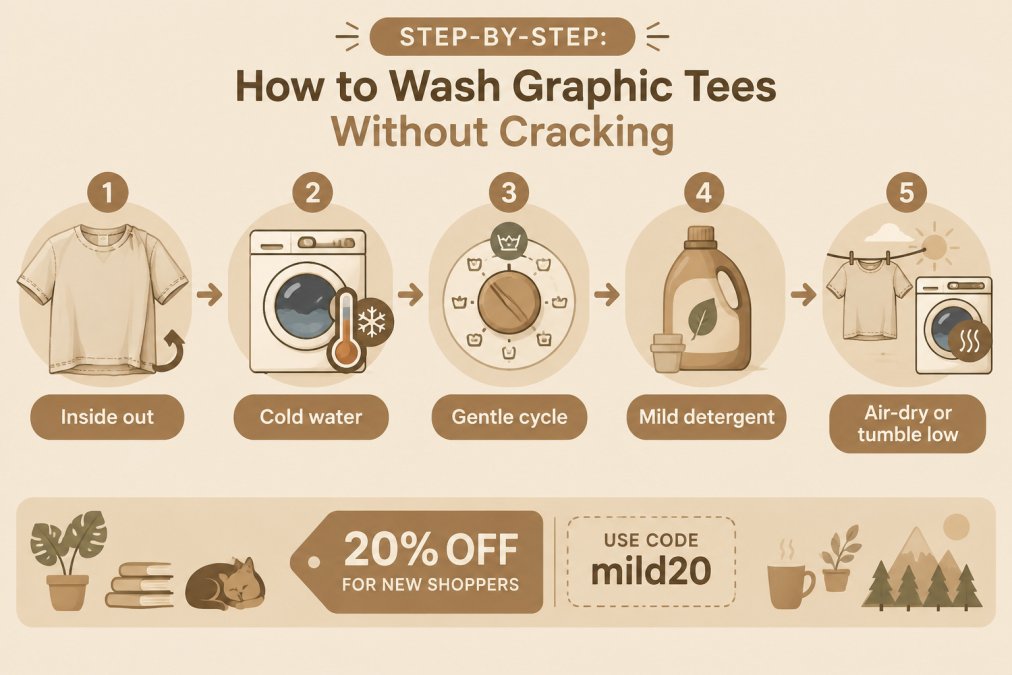
- Turn the shirt inside out so the print faces the inside of the drum.
- Zip any zippers and close Velcro so they do not snag.
- Pick a gentle or delicate cycle.
- Use cold water, around 30°C or 86°F.
- Add a small amount of mild detergent.
- Remove the shirt promptly when the cycle ends.
Turn the Shirt Inside Out and Use Cold Water
Turning the shirt inside out keeps the print from rubbing against the drum and other clothes. Cold water is the safest temperature for ink, because heat is what softens it.
Cold water also keeps the cotton from shrinking. This matters for fit as well as looks.
Choose a Gentle Cycle and Wash With Similar Colors
A gentle cycle slows the spin and reduces friction. Wash your graphic tees with other light or similar-colored items so dark dye does not bleed onto the print.
Keep the load small. A crowded drum creates more rubbing and more wear.
Choosing the Best Detergent for Graphic Tees
Detergent choice affects a print more than most people expect. The goal is to lift body oils and dirt without leaving residue or stripping dye, and that comes down to three variables: formula, dose, and water.
Pick a color-safe, bleach-free formula. Look for a liquid or gel labeled for colors or delicates. Powder detergents can be harder to dissolve fully in a cold wash, and undissolved granules can sit against the print and abrade it. Avoid anything with chlorine bleach, and treat oxygen bleach (color-safe bleach) as an occasional stain tool rather than a routine additive.
Dose below the bottle line. Detergent makers calibrate the cap for heavily soiled family loads, not a few graphic tees. Overdosing is the most common cause of a cloudy, dingy-looking print, because leftover surfactant and optical brighteners dry into a film on the ink. For a small, lightly soiled load, use roughly half the recommended amount; for a single shirt, a teaspoon or two of liquid is usually enough.
Account for water hardness. If your water is hard, detergent struggles to rinse clean and mineral film can dull both the print and the shirt color. A smaller dose of a hardness-targeting detergent, plus an extra rinse, can help clear residue better than adding more detergent. If you see white streaking or stiffness after drying, that is residue, not a cleaning problem.
Skip fabric softener and dryer sheets on printed shirts. Softeners coat fibers with a waxy layer that can make plastisol and vinyl prints look hazy and can weaken the ink-to-fabric bond over repeated washes. If you want softness, use wool dryer balls on air-dry or a low-heat cycle instead.
Match detergent to print method where you can. Screen-printed and plastisol prints tolerate standard color-safe liquid detergent well. Direct-to-film and heat-transfer vinyl prints are more sensitive to heat and solvent-heavy stain treatments, so pretreat stains with a dab of the same mild detergent rather than a spray-on solvent, and rinse promptly.
Watch out: pretreating a stain by scrubbing the print with a brush or undiluted detergent can lift ink at the edges, so blot from the back of the fabric and let the detergent dwell rather than agitate.
A simple rule: one mild, bleach-free liquid, dosed at half strength, with an extra rinse if your water is hard. That combination protects the print and the shirt color at the same time.
How to Keep Vinyl on Shirts From Cracking
Heat-transfer vinyl is a plastic film bonded to the fabric with an adhesive layer, and it fails differently from screen-printed ink. Where plastisol ink soaks into the fibers, vinyl sits on top, so it is more vulnerable to heat, abrasion, and repeated flexing at the same fold lines. That is why vinyl tends to crack in straight lines across the chest or at the shoulders rather than fade evenly.
What actually causes vinyl cracks:
- Dryer heat softens the adhesive and lets the film lift and re-bond in a stressed position, which starts hairline cracks.
- Washing in hot water does the same at a slower rate and can shrink the cotton underneath a vinyl print that does not shrink, putting the film under tension.
- Friction from a crowded drum scuffs the film's surface and dulls the finish before it cracks.
- Ironing directly on the design melts the film and fuses wrinkles into it permanently.
The vinyl-safe routine: turn the shirt inside out, wash cold on a gentle cycle with a mild detergent, skip fabric softener, and air-dry. If you must machine-dry, use the lowest heat and pull the shirt out while still damp. Never iron the print face; if you need to smooth the shirt, iron the back of the fabric on low with a pressing cloth between the iron and the vinyl.
What can and cannot be repaired. A cracked vinyl print cannot be fully restored, the film has physically separated. You can slow further cracking by air-drying, avoiding stacking heavy items on the shirt, and washing it less often. A lifted edge, by contrast, can sometimes be re-pressed at home with a pressing cloth and low iron, but only if the adhesive has not picked up lint or detergent residue; once it has, re-pressing usually fails. Faded vinyl (loss of color or shine) is not repairable at home.
Separate print fading from shirt fading. If the graphic looks dull but the cotton is still deep black or navy, the problem is the print and the fix is gentler washing and no dryer heat. If the whole shirt looks washed out, including the fabric around the print, the cause is usually dye loss from hot water, harsh detergent, or sun exposure while drying, and the remedy is cold water, color-safe detergent, and drying in shade. Treating the wrong one wastes effort: no detergent change will restore a cracked vinyl film, and no amount of gentle washing will bring back dye that has already bled out.
Watch out: stacking damp vinyl-printed shirts on top of each other before they are fully dry can press the film into a crease that sets permanently, so dry them flat or hang them separately.
The article breaks down the main causes of vinyl cracking and what can and cannot be repaired at home.
| Cause | Effect on vinyl | Fix |
|---|---|---|
| Dryer heat | Softens adhesive, starts hairline cracks | Air-dry or use lowest heat |
| Hot water washing | Shrinks cotton under film, adds tension | Wash cold on gentle cycle |
| Crowded drum friction | Scuffs and dulls the film surface | Wash with a smaller load |
| Ironing the print face | Melts film and fuses wrinkles | Iron the back on low with a pressing cloth |
Drying Graphic Tees Without Heat Damage
Air-drying is the best choice for graphic tees. Hang the shirt inside out on a rack or line, away from direct sun, which can fade color.
If you must use a dryer, pick the lowest heat setting and remove the shirt while it is still slightly damp. Heat is the most common cause of cracked prints, so keep it low.
How to Store Graphic Tees to Protect the Print
Fold your tees instead of hanging them. Hangers can stretch the neckline and leave pressure marks, and folding keeps prints flat.
Store them in a dry closet away from sunlight. A breathable storage bin or drawer works well for keeping tees fresh between wears.
Your Next Step: Set Up a Graphic Tee Care Routine
Keeping graphic tees bright takes a simple routine: wash inside out in cold water, use a mild detergent, air-dry, and fold for storage. Do this every time and your favorite designs will last much longer.
Ready to build a collection? Browse the Law of 2 Feet tee for a soft staple made of 100% ring-spun cotton, or check out the I'm Not Arguing graphic tee for a funny everyday pick. Shoppers can also browse Making Decisions Is Hard for a relaxed unisex fit. Every order ships free within the US, and new shoppers can save 20% with code mild20.



Frequently Asked Questions
How do I stop T-shirt graphics from fading?
Turn the shirt inside out, wash it in cold water on a gentle cycle, and use a mild detergent. Avoid bleach and fabric softener, which can break down the ink. Dry the shirt inside out on low heat or let it air-dry. Washing less often also helps, because every wash adds friction and wear to the print. These steps cover the main causes of fading in most graphic tees.
Is it better to wash graphic tees inside out?
Yes. Washing a graphic tee inside out puts the printed side away from the drum, the agitator and other garments, which reduces abrasion and friction on the design. This is one of the simplest steps you can take to slow print cracking and fading. Mild Statement tees are printed on demand and their care labels recommend machine washing cold, inside out, and tumble drying low.
Can you put graphic tees in the washing machine?
You can, as long as you use a cold, gentle cycle and turn the shirt inside out first. Avoid hot water and high-heat drying, since both speed up fading and cracking. Wash graphic tees with similar colors so dye does not transfer, and close any zippers or hook-and-loop fasteners on other items. Hand washing is also an option for shirts you want to protect most.
Can heat from a dryer make a graphic tee fade or crack?
Yes. High heat softens and stresses the ink film, which can lead to cracking and peeling over time. Tumble dry on low or air-dry the shirt flat or on a hanger, inside out if possible. Removing the shirt while it is still slightly damp can also reduce heat exposure and help the print last longer.