 How-to
How to Tell if Cotton Shirts Are Soft
Table of Contents
- How to Tell if Cotton Shirts Are Soft: The Hands-On Test
- Combed vs. Carded Cotton: Which Feels Better
- Cotton Fiber Content and Fabric Blends That Affect Softness
- Best Cotton for Graphic Tees: Fiber Length and Processing
- How to Soften Stiff Cotton Shirts: Finishes and Treatments
- Why Cotton Shirts Vary in Softness
- Your Cotton Softness Buying Checklist
- Frequently Asked Questions
Last Updated: October 11, 2026
How to Tell if Cotton Shirts Are Soft: The Hands-On Test
Softness matters when you're buying a cotton shirt. You can't always feel fabric before you order online, so knowing how to tell if cotton shirts are soft is crucial. At Mild Statement LLC, we focus on comfort because our customers wear these tees daily, at home, at work, out with friends. A stiff shirt gets abandoned in the drawer. A soft one becomes a favorite.

The good news: you can test softness without a laboratory. Your hands, cheek, and eyes tell you most of what you need to know.
Run Your Fingers Across the Fabric
Start with your fingertips. Lightly drag them across the surface of the shirt. Soft cotton feels smooth. Your fingers should glide without catching or dragging.
Rough cotton has a fuzzy or nubby texture. You'll feel resistance as you move your hand. This happens when short fibers stick up from the fabric surface.
Press down gently with your palm. A soft shirt feels almost slippery. A stiff one feels stiff, there's no other way to describe it.
What you're feeling: The fabric's surface finish. Cotton that's been processed to remove short fibers and smooth the surface will always feel softer to the touch than cotton with those fibers still intact.
Press the Fabric Against Your Cheek
Your cheek is more sensitive than your fingertips. This test reveals subtlety your hands might miss.
Hold the shirt up and gently press it against your cheek or neck. Soft cotton should feel almost cool and silky. It shouldn't irritate or feel rough.
If the fabric feels scratchy or prickly against your cheek, it's not as soft as it claims to be. Your skin will tell you the truth faster than your hands can.
Check for a Smooth Drape
Soft fabric drapes smoothly. Stiff fabric holds its shape too rigidly.
Lay the shirt flat and let a section hang over the edge of a table. Soft cotton will fold and flow naturally. Stiff cotton will hold sharp creases and folds.
This matters because soft fabric moves with your body. Stiff fabric fights against you.
Combed vs. Carded Cotton: Which Feels Better
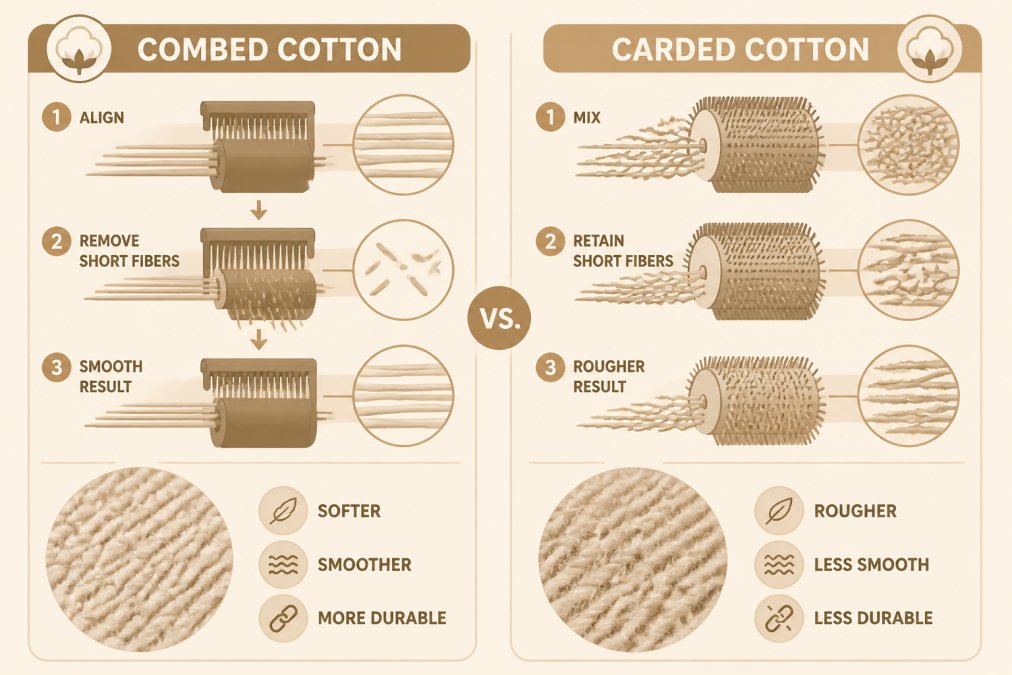
Combed cotton feels softer than carded cotton. Here's why: the combing process removes short fibers and impurities from the cotton before it's spun into yarn. Carded cotton skips this step.
When short fibers are removed, the fabric surface is smoother. When those fibers remain, they stick up and create a fuzzy texture. That's the difference between soft and rough.
Ring-spun cotton is another processing method that increases softness. Ring spinning twists the yarn tighter and more evenly than other methods. This creates a smoother, more durable thread.
Many quality graphic tees use ring-spun cotton. Our shirts at Mild Statement LLC use ring-spun cotton because we prioritize comfort. When you wear a shirt every day, that matters.

The trade-off: combed and ring-spun cotton cost more to produce. Cheaper shirts use carded cotton because it's faster and cheaper.
Cotton Fiber Content and Fabric Blends That Affect Softness
100% Cotton vs. Cotton Blends
Pure cotton can be very soft, but only if it's processed well. A 100% cotton shirt made from high-quality fiber will feel softer than a low-quality 100% cotton shirt.
Cotton blends mix cotton with other fibers, usually polyester. Here's what happens:
- 100% cotton: Softer, more breathable, but can shrink and wrinkle more
- Cotton/polyester blend: Slightly less soft, but more durable and wrinkle-resistant
- High cotton content (80%+ cotton): Feels closer to pure cotton while gaining some durability
A 90% cotton, 10% polyester blend feels almost identical to 100% cotton. A 50/50 blend feels noticeably different, less soft, more structured.
Read the tag. If a shirt is 100% cotton, it will say so. If it's a blend, the percentage of each fiber will be listed. Higher cotton content means softer fabric.
Pima and Egyptian Cotton Quality
Pima cotton has longer fibers than standard cotton. Longer fibers create smoother yarn, which creates softer fabric. Pima cotton is considered a premium option.
Egyptian cotton is also prized for softness. It comes from a specific region and variety of cotton plant. The fiber length is typically longer than standard cotton.
Both sound fancy, but here's the reality: a well-processed standard cotton can feel as soft as poorly processed Pima. The processing matters as much as the fiber type.
When you see "Pima" or "Egyptian" on a label, you're usually paying more for the name than for a dramatic softness difference. That said, these fibers do have genuine advantages for durability and longevity.
Best Cotton for Graphic Tees: Fiber Length and Processing
Longer fibers create softer fabric. This is the most important factor in softness, after processing.
Short-staple cotton has fibers around 1 inch long. It's cheaper and rougher.
Long-staple cotton has fibers 1.25 inches or longer. It's softer and more durable.
When you buy a graphic tee, look for "long-staple" or "ring-spun" in the description. These terms tell you the shirt is made from better material.
Processing matters equally. Even long-staple cotton can feel rough if it's carded instead of combed. Even short-staple cotton can feel acceptable if it's heavily finished and treated.
The combination of long-staple fiber plus combing plus finishing treatments creates the softest shirts.
How to Soften Stiff Cotton Shirts: Finishes and Treatments
Some stiff shirts can be softened. Some can't. It depends on why they're stiff.
Mercerized and Pre-Washed Treatments
Mercerizing treats cotton with alkaline solution. This swells the fibers and makes them smoother and more lustrous. Mercerized cotton feels softer and holds dye better.
Pre-washing shrinks and softens the fabric before it's sold. Pre-washed shirts feel softer right away and won't shrink as much when you wash them at home.
Look for these terms on the label. They're signs the manufacturer invested in making the shirt softer.
Softness Before and After Laundering
New shirts sometimes feel stiff. This is normal. The finishing chemicals used in manufacturing can make fabric feel stiff until they wash out.
First wash: Most new cotton shirts feel noticeably softer after one wash. The finishing chemicals rinse away.
After 5-10 washes: Cotton continues to soften as fibers relax and break down slightly. A shirt that felt okay when new often feels great after a few months of wear.
After 20+ washes: Cotton that was soft stays soft. Cotton that was rough stays rough. Washing doesn't change the fundamental fiber quality.
This means a shirt that feels stiff when new might be worth keeping. But a shirt that feels rough when new will probably always feel rough.
Why Cotton Shirts Vary in Softness
Weave, Weight, and Shirt Construction
Weave type affects how the fabric feels. A jersey knit (the most common for tees) is soft because the loops of yarn create a stretchy, flexible surface.
Weight matters too. Heavier cotton (measured in ounces per square yard) feels more substantial. A 4.5 oz/yd² shirt feels lighter and softer than a 6 oz/yd² shirt.
Lighter isn't always better, though. A 4.5 oz/yd² shirt is more breathable and drapes better, but a 6 oz/yd² shirt is more durable.
Construction details like double-stitched seams, shoulder taping, and quarter-turn construction affect how the shirt feels and lasts. These details don't directly affect softness, but they affect how the shirt wears over time.
Separating Softness from Breathability and Stretch
Soft doesn't always mean breathable. A heavily finished cotton can feel soft but trap heat. A lighter, less-finished cotton can feel rougher but breathe better.
Stretch is different from softness. A cotton-polyester blend might feel less soft but stretch more. Some people prefer the feel of a shirt that moves with them.
Don't confuse these qualities. A soft shirt that doesn't breathe might feel uncomfortable in summer. A breathable shirt that's not soft might feel scratchy.
Test what matters to you. If you wear tees in warm weather, breathability might matter more than ultimate softness. If you wear them at home or in cool weather, softness is the priority.
Your Cotton Softness Buying Checklist
Use this checklist when shopping for soft cotton shirts:
- Run your fingers across the fabric, does it feel smooth?
- Press it against your cheek, does it feel soft or scratchy?
- Check the fiber content, is it 100% cotton or a high-cotton blend?
- Look for processing terms, combed, ring-spun, mercerized, or pre-washed?
- Check the weight, 4-5 oz/yd² is soft and breathable
- Read the label for fiber type, long-staple cotton is softer than short-staple
- Consider the weave, jersey knit is typically softer than other weaves
- Check return policy, can you return it if it's not as soft as expected?
When you're ordering online, read the product description carefully. Look for the terms above. If a shirt is vague about fiber content or processing, that's often a sign it's not premium quality.
At Mild Statement LLC, we use ring-spun cotton and keep our shirts at 4.5 oz/yd² for that perfect balance of softness and durability. When you buy from us, you're getting a shirt we'd actually wear.
Frequently Asked Questions
Does 100% cotton automatically mean a shirt will be soft?
Not necessarily. Fiber content is just one factor. A shirt can be 100% cotton but still feel rough if it's made from short-staple fibers, carded instead of combed, or finished with starch or sizing. Run your fingers over the fabric and check the label for processing details. Combed cotton and longer fibers typically feel softer than standard carded cotton, even at 100%.
What is the difference between carded and combed cotton?
Carded cotton is the standard process: fibers are aligned but short fibers and impurities remain, resulting in a rougher texture. Combed cotton removes those short fibers and debris, leaving longer, smoother fibers that feel softer and more durable. Combed cotton costs more but delivers noticeably better softness and longevity, making it ideal for graphic tees designed for everyday wear.
How can I tell if a cotton shirt will soften after washing?
Most cotton shirts do soften with washing because water and detergent relax the fibers and remove manufacturing finishes like sizing and starch. Check the label for 'pre-washed' or 'preshrunk' notation, these shirts have already undergone that process and will feel soft immediately. If the shirt feels stiff in the store, it likely has finishing treatments that will wash out, but starting with a naturally soft fabric saves you that wait.
Is Pima or Egyptian cotton softer than regular cotton?
Pima and Egyptian cotton are long-staple varieties with longer, finer fibers, which typically feel softer and more durable than standard cotton. However, softness also depends on processing: a combed standard cotton can feel nearly as soft as an unprocessed Pima. Check both the fiber type and whether it's been combed. For graphic tees, ring-spun combed cotton offers excellent softness at a reasonable price point.
Softness is personal. What feels perfect to one person might feel too thin to another. The best way to know if a shirt will work for you is to test it with your hands and your skin. Use the tests above before you buy. If you're ordering online and can't feel the fabric first, read the product details carefully and check the return policy. A good shirt should feel soft from day one, and stay soft after washing.