 How-to
How Long Does Custom Shipping Take: A Complete Timeline
Table of Contents
- Understanding Custom Shipping: Production, Processing, and Transit
- Custom T-Shirt Production Time: What Happens Before Your Order Ships
- Print-on-Demand Shipping Time: From Ready to Ship to Your Door
- Print-on-Demand Order Tracking: How to Monitor Your Custom Order
- Custom Shirt Shipping Delays: Why They Happen and How to Prevent Them
- Timeline Examples: Made-to-Order vs. In-Stock Items
- Ordering a Custom Shirt for an Event: Planning Your Timeline
- Frequently Asked Questions
Last Updated: October 21, 2026
Understanding Custom Shipping: Production, Processing, and Transit
How long does custom shipping take? It depends on three phases: production (making your item), processing (preparing it for shipment), and transit (delivery). Most custom orders take 7-21 business days from order to doorstep, varying by product type, order volume, and destination.
At Mild Statement LLC, we know timing matters. Custom products aren't sitting on a shelf, they're made after you order, which adds production time upfront but ensures nothing goes to waste.
Custom T-Shirt Production Time: What Happens Before Your Order Ships
Custom t-shirt production time is usually the longest part of the journey. Production typically takes 3-7 business days, depending on order volume and design complexity.
Here's what affects production speed:
- Order volume: High-demand periods (holidays, back-to-school) slow production
- Design complexity: Simple single-color prints are faster than multi-color designs
- Shirt type: Standard tees print faster than specialty items
- Current capacity: Printers have limits on how many items they can produce daily
Proof Approval and Personalization Steps
Before production starts, your design goes through proof approval, where you review how it looks on your specific shirt color and size. This typically takes 1-2 business days, and changes add time, approving quickly keeps production on schedule. Personalization (names, dates, custom text) adds 1-2 days because each item is unique.
Print Capacity and Order Volume
Print capacity matters. When a shop runs at full capacity, your order waits in a queue, during peak seasons, production can stretch from 3 days to 10 or more. Off-peak periods (typically January through August) move faster, so ordering during slower months reduces delays.
Print-on-Demand Shipping Time: From Ready to Ship to Your Door
Once production finishes, your shirt moves into fulfillment: quality checks, packing, and carrier handoff, typically 1-3 business days. Transit time then depends on your location and shipping method.
Standard Shipping vs. Expedited Options
Standard shipping takes 5-10 business days after dispatch. This is the most affordable option and works well if you're not in a rush. Standard shipping covers most domestic destinations.
Expedited shipping cuts transit time to 2-4 business days. This costs more but gets your custom shirt to you faster. Choose expedited if you have a deadline, like a birthday, event, or special occasion.
Domestic Shipping and Special Regions
Most domestic orders ship via USPS, UPS, or FedEx. Nearby destinations (within 500 miles) take 3-5 business days, cross-country 7-10, and remote areas longer. Alaska and Hawaii typically take 2-3 weeks due to special handling and longer routes.
Print-on-Demand Order Tracking: How to Monitor Your Custom Order
Once your shirt ships, the tracking number becomes your best source of truth, if you know what each scan means. Most orders move through four phases: label created, accepted by carrier, in transit, and out for delivery. Knowing typical durations helps you tell a normal lull from a genuine delay.
What Tracking Information Tells You
Your tracking number shows the carrier, current scan location, and estimated delivery date. Scans update as the package moves, sometimes not for 24-48 hours during line-haul moves between hubs. "Label created" for a day or two is normal, the label was generated but the carrier hasn't scanned the package yet.
Tracking tells you:
- Current package location and the last scan time
- Estimated delivery window (a projection, not a promise)
- Any exception scans such as "address issue" or "weather delay"
- When the carrier attempts delivery
Keep your tracking number and order confirmation handy. If you need to contact the seller or the carrier, both speed up the investigation.
Interpreting Status Updates and Estimated Delivery Dates
Status updates follow a standard pattern: "label created" means fulfillment generated the label, "accepted" means the carrier has it, "in transit" means it's moving, "out for delivery" means it's on a vehicle, and "delivered" confirms arrival. Estimated dates are projections; weather, holidays, and volume can shift them by 1-2 days.
If your estimated delivery date passes without arrival, don't panic immediately. Carriers sometimes update dates as packages move. Give it 2-3 extra business days before contacting support.
When Tracking Stalls: A Practical Escalation Path
A stalled tracking page is the most common source of anxiety. Use this sequence:
- No scan for 48 hours after "label created": Normal during handoff. Check again the next business day.
- No scan for 3-5 business days after "accepted": Contact the seller to confirm the handoff date and open a carrier trace.
- Exception scan (address, damage, weather): Contact the seller immediately.
- Delivered scan but no package: Check with neighbors and your mail area, then contact the carrier the same day.
- 5+ business days past the estimate with no movement: Ask the seller to file a claim or reship.
Custom Shirt Shipping Delays: Why They Happen and How to Prevent Them
Delays happen. Understanding common causes helps you avoid them or plan around them.
Common Causes of Delays
Production backlog is the most common delay. High order volume means longer waits before printing starts.
Design issues can pause production. Unclear files, missing colors, or technical problems require fixes before printing can begin.
Carrier delays happen during peak seasons. The postal service and shipping carriers handle millions of packages daily. During holidays or major events, delays are normal.
Address issues cause delays too. Incomplete or incorrect addresses force carriers to contact you or attempt redelivery. This adds 2-5 days to your timeline.
Weather and natural events can slow carriers. Snowstorms, hurricanes, and other disruptions delay entire regions.
Reducing Delays Before and After Ordering
Start with a clear, complete address. Double-check spelling, zip codes, and apartment numbers. An accurate address prevents carrier delays.
Order early if you have a deadline. Don't wait until the last week to order a custom gift. Build in buffer time for production and shipping.
Choose expedited shipping if your timeline is tight. It costs more but guarantees faster transit.
Respond quickly to any requests from the seller. If they need clarification on your design, answer immediately. Delays here cascade through the entire timeline.
Timeline Examples: Made-to-Order vs. In-Stock Items
General ranges are useful, but a realistic delivery date comes from adding up the stages for your specific product and destination. Below are scenario-based estimates that show how the same custom order can land anywhere from about a week to several weeks depending on product, shipping service, and location. Treat these as planning ranges, not guarantees, production volume and carrier conditions can shift any stage.
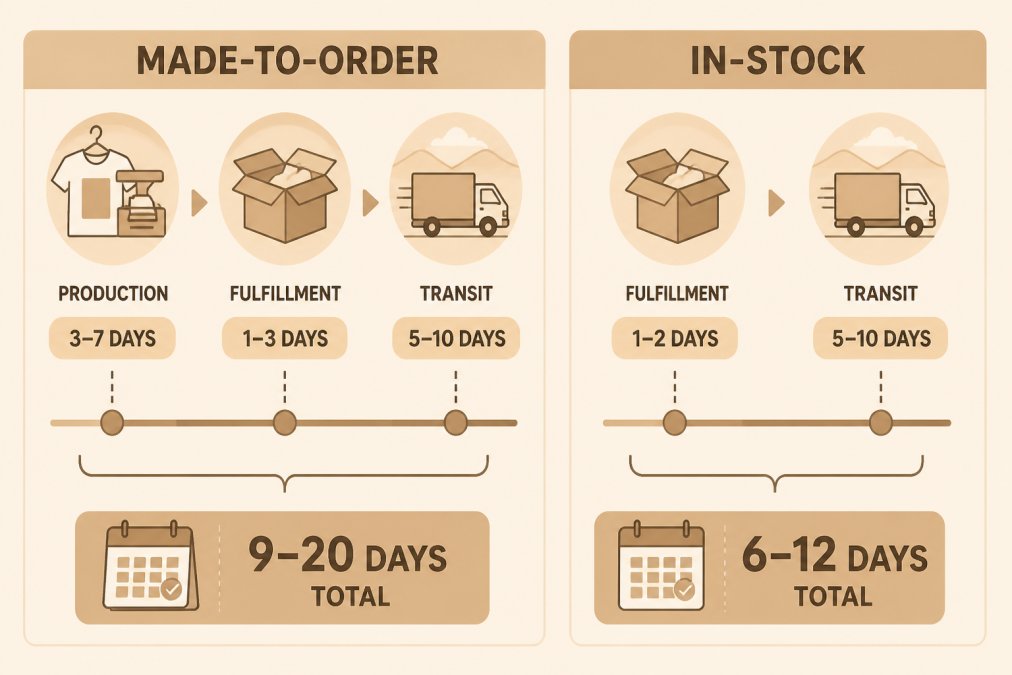
Made-to-order items (like custom t-shirts) follow this timeline:
- Production: 3-7 business days
- Fulfillment: 1-3 business days
- Transit: 5-10 business days (standard) or 2-4 business days (expedited)
- Total: 9-20 business days (standard) or 6-14 business days (expedited)
In-stock items skip production entirely:
- Fulfillment: 1-2 business days
- Transit: 5-10 business days (standard) or 2-4 business days (expedited)
- Total: 6-12 business days (standard) or 3-6 business days (expedited)
The production phase is what makes custom orders take longer. You're trading speed for personalization, your item is made specifically for you.
Scenario-Based Estimates by Product and Destination
Use these examples to translate the ranges into a realistic order-to-door date. Each scenario assumes a proof is approved within 1 business day and no design revisions are needed.
| Scenario | Production | Fulfillment | Transit | Total (business days) |
|---|---|---|---|---|
| Single-color custom t-shirt, standard shipping, nearby destination | 3-5 days | 1-2 days | 3-5 days | 7-12 days |
| Multi-color custom t-shirt, standard shipping, cross-country | 5-7 days | 1-3 days | 7-10 days | 13-20 days |
| Personalized t-shirt (name/date), expedited shipping, nearby destination | 5-7 days | 1-2 days | 2-4 days | 8-13 days |
| Custom t-shirt, standard shipping, Alaska or Hawaii | 3-7 days | 1-3 days | 10-14 days | 14-24 days |
| In-stock blank tee, standard shipping, cross-country | None | 1-2 days | 7-10 days | 8-12 days |
A few patterns stand out. Personalization adds 1-2 days to production because each item is set up individually. Cross-country transit roughly doubles the standard transit window compared with nearby destinations. Alaska and Hawaii add a week or more because packages move through fewer direct routes and may require special handling.
Building Your Own Estimate
To estimate your own order-to-door date, add four numbers: production days for your product and design complexity, proof approval days (usually 1 if you respond quickly), fulfillment days (1-3), and transit days for your shipping service and destination. Then add a buffer of 2-3 business days for peak-season volume or carrier variability.
Ordering a Custom Shirt for an Event: Planning Your Timeline
Event deadlines require backward planning. Here's how to ensure your custom shirt arrives in time.
Six weeks before the event: Order now. This gives you maximum buffer time.
Four weeks before: Still safe. Standard production and shipping should get you there.
Two weeks before: Risky. Production queues might be long. You'll likely need expedited shipping. Order immediately if you proceed.
One week before: Very risky. Production might not finish in time. Expedited shipping becomes necessary but may not be enough.
Less than one week: Don't order. Production won't finish, and even expedited shipping won't help. Look for in-stock alternatives instead.
Custom shipping timelines aren't mysterious once you break them down. Learn more about how print-on-demand reduces waste and supports sustainable shopping.
Frequently Asked Questions
What is the difference between production time and shipping time for custom orders?
Production time is how long it takes to create your custom shirt, printing, dyeing, or embroidering your design onto the blank garment. Shipping time is how long the carrier takes to deliver it after the shirt is finished and dispatched. Custom shipping includes both. For example, a custom order might take 5 business days to produce and 3-5 business days to ship, totaling 8-10 business days or more depending on your destination and carrier.
How long does it take to print and ship a custom T-shirt?
Most custom T-shirts take 2-5 weeks from order to delivery. The timeline breaks down into processing (1-2 business days), production (3-7 business days), and transit (2-5 business days depending on shipping method and destination). Made-to-order items typically take longer than in-stock selections because the shirt must be produced after you order. Expedited shipping can reduce transit time but does not speed up production.
How can I track a custom order and what should I do if it's delayed?
Once your custom order ships, you'll receive a tracking number from the carrier. Use it to monitor progress through production, dispatch, and transit phases. Tracking updates show your order's location and estimated delivery date. If your order is delayed beyond the estimated window, check for carrier delays or unforeseen circumstances like weather. Contact customer support with your tracking number if the delay extends significantly beyond the quoted estimate.
Does custom shipping time include weekends and holidays?
No. Production and processing times are typically quoted in business days, which exclude weekends and holidays. Shipping transit time may include weekends depending on the carrier, but holidays can cause delays. For example, an order placed on a Friday may not start processing until Monday. If you're ordering for a specific event or deadline, account for business-day calculations and check your carrier's holiday schedule to avoid missing your target delivery date.