 blog
Best ThreadOutLoud Alternatives 2026: Buying Guide
Table of Contents
- What to Compare in ThreadOutLoud Alternatives for 2026
- Funny Graphic Tee Brands That Match ThreadOutLoud's Humor
- Comfortable Graphic T-Shirts: What Separates Soft From Stiff
- Print-on-Demand Clothing Brands and How They Actually Work
- Sustainable Graphic Tees: How to Tell Real Claims From Marketing
- Disabled Veteran-Owned and Small-Batch Brands: What the Label Means
- Common Mistakes When Switching Tee Brands
- Conclusion
- Frequently Asked Questions
Last Updated: October 12, 2026
What to Compare in ThreadOutLoud Alternatives for 2026
If you're hunting for the best ThreadOutLoud alternatives in 2026, the smartest first move is to stop comparing logos and start comparing what actually touches your skin.
ThreadOutLoud alternatives are simply other apparel brands that sell comparable graphic tees, whether that means print-on-demand shops, small-batch labels, or veteran-owned operations. The category has gotten crowded, and the marketing has gotten louder.
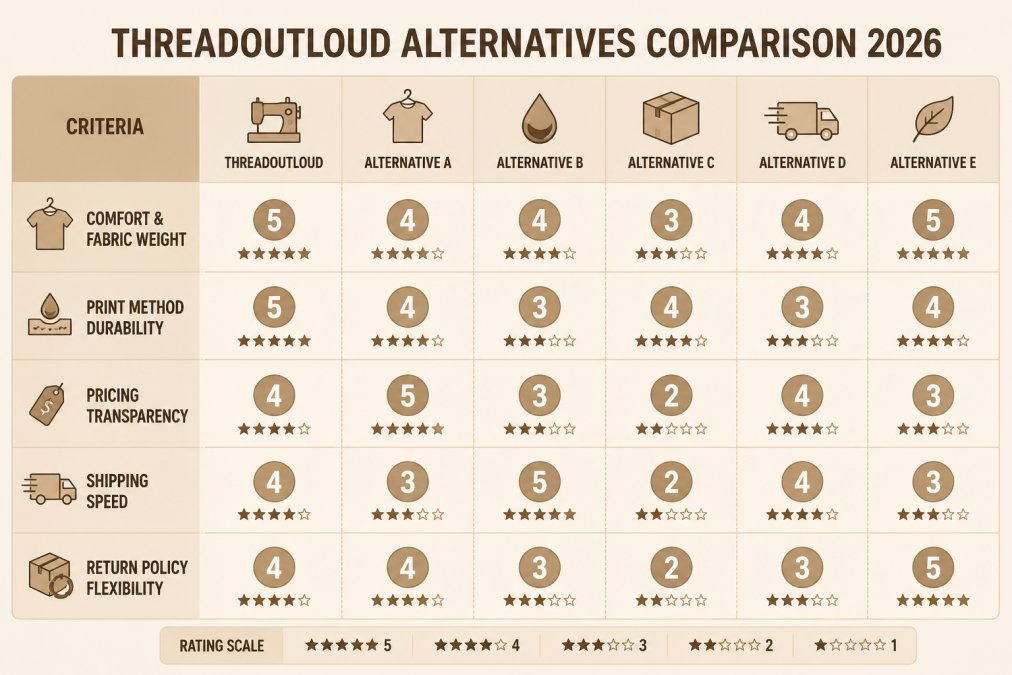
Comfort and Fabric Quality
Fabric is where most comparisons should begin, because it's the one thing you can't fix after purchase. A shirt can have the funniest design on the internet, but if the cotton is thin, scratchy, or stiff, it stays folded in the drawer.
Two specs matter most: fabric weight and fiber blend. Heavier combed cotton tends to drape better and survive more washes, while ring-spun cotton feels smoother against skin because the fibers are twisted tighter.
Here's the honest limitation: you can't feel a shirt through a screen. That's why return policies matter as much as fabric specs. Any brand worth switching to should tell you the fabric weight and blend upfront, in plain numbers, not adjectives.
Print Method and Production Ethics
Print method decides whether your design looks crisp in year two or cracked by month three. Screen printing lays down thick, durable ink and suits bold graphics. Direct-to-garment printing handles detailed, full-color designs and works well for made-to-order production, which is why so many print-on-demand clothing brands rely on it.
Production ethics is the murkier half. A brand can claim sustainability without proving anything. Look for specifics: what the shirts are printed on demand rather than mass-produced, whether unsold inventory exists at all, and whether the company names its printing partners. Vague language like "eco-friendly practices" means nothing without a mechanism behind it.
Pricing, Shipping, and Returns
Total cost is never just the sticker price. Shipping, return postage, and how long you wait all change what a shirt actually costs you.
- Listed price: what you see at checkout
- Shipping: free, flat-rate, or calculated at checkout
- Return window: how long you have to change your mind
- Who pays return postage: the detail most shoppers discover too late
Pricing for graphic tees varies widely by brand, print method, and fabric, so we won't quote numbers that go stale. Check each brand's site for current pricing. What you can compare today is transparency: does the brand state shipping timelines and return terms clearly before you buy, or bury them?
Funny Graphic Tee Brands That Match ThreadOutLoud's Humor
Humor is subjective, and that's exactly why so many ThreadOutLoud alternatives disappoint people. A brand can nail the aesthetic and still miss the joke.
The brands that get this right tend to target specific identities rather than broad punchlines. Plant parents, bookworms, cat lovers, coffee drinkers, and introverts all have inside jokes that land harder than generic sarcasm.
This is the space Mild Statement LLC lives in. The catalog covers plant parents, bookworms, cat lovers, coffee drinkers, introverts, and outdoor wanderers, which means you can find a shirt that fits your personality instead of settling for the closest match.
One warning: humor-driven brands often lean on the same handful of jokes. If you've seen a design on three other sites, it's probably a stock phrase, not an original.
Comfortable Graphic T-Shirts: What Separates Soft From Stiff
Softness comes down to three things: fiber type, yarn spinning, and how the shirt is finished. Get all three right and the tee feels broken-in on day one. Miss one and you get the stiff, boxy feel people associate with cheap promotional shirts.
Combed cotton removes short fibers, leaving longer strands that feel smoother. Ring-spun yarn is twisted tighter and thinner, which adds softness without adding weight. Garment washing or a softener finish at the factory removes residual stiffness before the shirt ever reaches you.
What most guides miss is that fit affects perceived softness too. A shirt that's cut too narrow pulls at the shoulders and chest, and that tension reads as uncomfortable even when the fabric is fine.
Print-on-Demand Clothing Brands and How They Actually Work
Print-on-demand clothing brands print each shirt after you order it, rather than manufacturing inventory in advance and hoping it sells. That model changes almost everything about the buying experience: no unsold stock, no warehouse clearance, but also no same-day shipping.
Here's how the process typically runs:
- You place an order on the brand's site
- The order routes to a printing facility
- The design is printed onto a blank shirt
- The finished shirt ships directly to you
Because nothing is printed until it's bought, print-on-demand produces less waste than traditional retail, which overproduces and discounts the leftovers. The tradeoff is production time. Most orders need a few business days to print before shipping even starts, so if you're buying a gift, order early.
What This Means If You're Leaving ThreadOutLoud
Most alternatives roundups skip the part that actually matters when you switch: what happens to the designs, orders, and account data you already have. ThreadOutLoud built its following on personality-driven tees, and if you've bought from it before, you likely have a purchase history, saved designs, or an account you'd rather not abandon blindly. Before you migrate, confirm four things with any replacement brand:
- Design portability. Can you upload your own artwork, or are you limited to the brand's catalog? A print-on-demand shop that accepts custom uploads lets you carry a design forward; one that doesn't means starting over.
- Order history and receipts. Download any past receipts or order confirmations you need for warranty, expense, or tax purposes before you close an account. Most brands let you export these from your account page, but not all do.
- Account deletion. If you're leaving for good, ask how to delete your account and what happens to your stored payment method and address. A brand that makes deletion hard is a brand that plans to keep marketing to you.
- File formats. If you're moving a design, check what file types the new brand accepts. Vector files scale cleanly to any print size; low-resolution raster files often can't be reprinted larger without visible blur.
This is the part of the switch most guides ignore, and it's the part that determines whether moving brands is a clean break or a slow leak of your time.
The Sustainability Question, Answered Concretely
This is also where you should ask hard questions of any brand claiming sustainability. Print-on-demand is a genuine mechanism, not a slogan. If a brand prints on demand, it can say so plainly and explain how. If it can't explain the mechanism, the claim is decoration. The Federal Trade Commission's Green Guides set the standard for how environmental marketing claims should be substantiated, and they're a useful reference when a brand's language starts sounding suspiciously soft.
Sustainable Graphic Tees: How to Tell Real Claims From Marketing
Sustainability claims in apparel range from verifiable to meaningless, and the difference usually shows up in specificity. A real claim names a mechanism. A marketing claim names a feeling.
Ask these questions before trusting any eco-friendly pitch:
- Does the brand print on demand, or produce inventory in advance?
- Does it name its fabric suppliers or printing partners?
- Does it explain what happens to unsold or returned items?
- Does it use vague words like "conscious" without any detail?
Print-on-demand is one of the few sustainability claims you can verify from the outside, because the model itself prevents overproduction. Beyond that, look for brands willing to talk about their supply chain in concrete terms. If a brand can't explain how its process reduces waste, treat the claim as decoration.
The Federal Trade Commission's Green Guides set the standard for how environmental marketing claims should be substantiated, and they're a useful reference when a brand's language starts sounding suspiciously soft.
Disabled Veteran-Owned and Small-Batch Brands: What the Label Means
"Veteran-owned" and "small-batch" get used loosely, so it helps to know what each one actually signals.
Veteran-owned means a business is at least partially owned and controlled by a veteran. Verification varies.
Small-batch means a brand produces in limited runs rather than mass quantities. It usually signals more attention per item and less waste, though it can also mean slower restocks and higher per-unit costs.
Neither label guarantees quality. What they do offer is a reason to look closer at how a brand operates, which is often more informative than the label itself.
Mild Statement LLC is a disabled veteran-owned small business, and every order ships free, which takes one variable out of the cost comparison.
Common Mistakes When Switching Tee Brands
Most bad brand switches come down to a handful of avoidable errors. Here's what to watch for:
- Buying on design alone. A great graphic on a scratchy blank is still a scratchy shirt.
- Ignoring fabric specs. If a listing won't state the blend and weight, that's a signal.
- Assuming free shipping means marked-up prices. Compare the total, not the line item.
- Skipping the return policy. Return windows and who pays postage vary a lot.
- Ordering a gift too late. Print-on-demand adds production time before shipping.
- Trusting sustainability language without a mechanism. Print-on-demand is verifiable; "eco-conscious" usually isn't.
Conclusion
Switching tee brands is a small decision with an outsized failure rate, mostly because shoppers compare designs instead of fabric, print method, and return terms. Get those three right and you rarely end up with a drawer full of unworn shirts.
At Mild Statement LLC, we built our catalog around that idea. Every shirt is printed on demand, so nothing goes to waste, every order ships free, and the designs are made for plant parents, bookworms, cat lovers, coffee drinkers, introverts, and outdoor wanderers. New shoppers can take 20% off with code mild20.
Get started with Mild Statement LLC and find a soft, comfortable graphic tee that says something without shouting.
Frequently Asked Questions
What are the best alternatives to ThreadOutLoud in 2026?
The best ThreadOutLoud alternatives depend on what you value most. If humor and softness matter, look at funny graphic tee brands that use ring-spun cotton and water-based inks. If ethics drive your choice, prioritize print-on-demand clothing brands with published production practices. If you want to support small businesses, disabled veteran-owned shops like Mild Statement combine comfortable graphic T-shirts with no-waste printing and free shipping.
How can I tell whether a graphic tee brand is actually sustainable?
Ask three questions: does the brand print on demand or hold inventory, what inks and fabrics does it use, and does it publish its production partners? Sustainable graphic tees usually ship from a print partner only after you order, which reduces deadstock. Brands that share certifications or supplier names are easier to trust than ones that only use the word eco-friendly on a landing page.
What should I compare when choosing a graphic T-shirt brand?
Compare fabric weight and blend, print method, size range, shipping speed, and return policy. Also check whether the brand prints on demand and how it handles exchanges. For funny graphic tee brands, look at design variety so you are not stuck with one joke repeated across ten shirts. Reading the return policy before ordering saves hassle if the fit is off.
Are print-on-demand shirts lower quality than screen-printed ones?
Not automatically. Print-on-demand clothing brands using direct-to-garment printing on quality blanks can produce shirts that feel soft and hold up through many washes. The variables are the blank shirt and the ink, not the production model. Ask what blank the brand prints on and whether it uses water-based or plastisol inks. Water-based inks tend to feel lighter on the fabric.