 blog
Are Veteran-Owned Shirts More Expensive? A Real Breakdown
Last Updated: October 26, 2026
Quick Summary
Are veteran owned shirts more expensive? Not necessarily. Veteran-owned shirts often cost more than mass-produced alternatives, but the price difference depends on what you're comparing. A veteran-owned brand using premium materials may cost the same as another small brand with similar quality standards.
- Fabric quality, production method, design complexity, and overhead structure determine shirt pricing across all brands.
- Print-on-demand production adds per-unit cost compared to bulk screen printing but eliminates inventory waste.
- Compare identical specifications across brands to determine if a veteran-owned premium exists.
- Verify veteran ownership through state registries, business documentation, and the brand's mission statement.
- Where profits go matters: ask if brands donate to veteran nonprofits or employ other veterans.
Table of Contents
- Are Veteran-Owned Shirts More Expensive? The Short Answer
- What Actually Drives the Cost of Veteran-Owned Shirts
- How to Verify a Veteran-Owned Business Before You Buy
- Veteran-Owned Apparel Quality and What It Actually Means
- Print-on-Demand Shirts and How Production Method Affects Price
- Veteran-Owned Brands That Support Veterans: Where Your Money Goes
- Making Your Decision: Cost Versus Value
- Frequently Asked Questions
Are Veteran-Owned Shirts More Expensive? The Short Answer
The short answer to whether are veteran owned shirts more expensive is: not necessarily. Veteran-owned shirts often cost more than mass-produced alternatives, but the price difference depends entirely on what you're comparing. A veteran-owned brand using print-on-demand production and premium cotton will cost more than a fast-fashion tee. Compare it to another small brand with similar quality standards, and the price might be identical. At Mild Statement LLC, we've built our business around the idea that you shouldn't have to overpay just to support a veteran-owned company. Our shirts use print-on-demand production, premium materials, and free shipping, which means you're not subsidizing inventory waste or logistics costs. The real question isn't whether are veteran owned shirts more expensive. It's whether you're getting genuine value for what you're paying.
What Actually Drives the Cost of Veteran-Owned Shirts
The price of any shirt, veteran-owned or not, comes down to four factors: fabric quality, production method, design complexity, and overhead structure. Understanding these helps you spot a fair price from an inflated one, and it lets you separate ownership from product specifications.
Fabric matters most. A 100% cotton shirt costs more to produce than a cotton-polyester blend. Heavier-weight cotton (like 6-ounce garment-dyed fabric) runs higher than lightweight alternatives. This is true across all brands, not just veteran-owned ones. When you see a veteran-owned brand priced higher, check the fabric weight and composition first.
Production method is the second major factor. Print-on-demand means each shirt prints individually after you order it. This eliminates bulk inventory waste but adds per-unit production cost compared to screen printing 500 shirts at once.
Design complexity affects pricing too. A simple one-color print costs less than a multi-color design or embroidery. Some veteran-owned brands invest in original artwork, which increases upfront costs that get reflected in the final price.
Overhead structure is where veteran-owned businesses often differ from corporate retailers. A small team handles everything: design, customer service, shipping. A large corporation spreads those costs across thousands of units.
A Like-for-Like Price Comparison
To answer whether veteran-owned shirts are more expensive, compare shirts with identical specifications. In other words, the veteran-owned premium is often zero once you control for quality.
Print-on-demand shirts add another layer. The difference here is usually brand mission and overhead, not production cost.
Total Checkout Cost, Not Just Sticker Price
Sticker price is only part of the story. Shipping, taxes, and discounts can swing the total by 15-25%. Many veteran-owned brands offer free shipping, while mainstream retailers may charge for standard shipping. Sales tax applies based on your state and the seller's nexus. Always compare the final cart total, not the product page price.
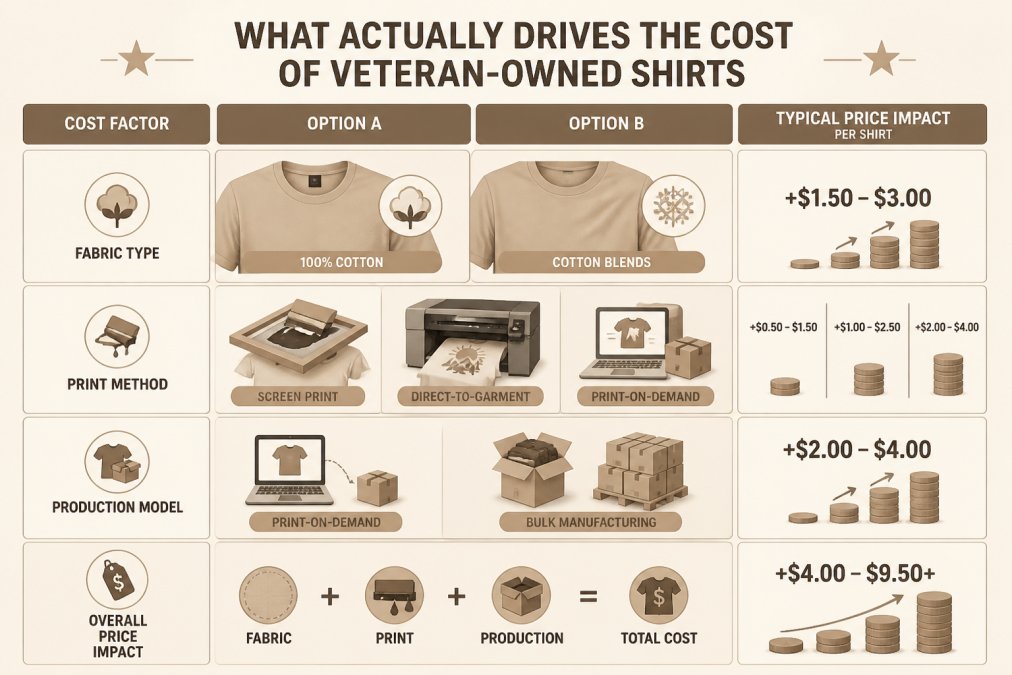
Several key factors determine the price of veteran-owned shirts, independent of ownership status.
| Factor | Impact on Price | Details |
|---|---|---|
| Fabric quality | Higher cost | 100% cotton costs more than cotton-polyester blends |
| Fabric weight | Higher cost | 6-ounce garment-dyed fabric costs more than lightweight alternatives |
| Production method | Varies | Print-on-demand adds per-unit cost; screen printing cheaper at volume |
| Design complexity | Higher cost | Multi-color or embroidered designs cost more than simple one-color prints |
| Overhead structure | Moderate impact | Small teams have lower overhead than corporations but higher per-unit costs than fast-fashion chains |
How to Verify a Veteran-Owned Business Before You Buy
Veteran ownership claims matter, but they're easy to fake. Before spending money, verify that a brand is genuinely veteran-owned and that your purchase actually supports a veteran.
Start by checking the business registration. Learn more about this veteran-owned brand and its mission to verify ownership credentials directly from the source. Many states maintain a veteran-owned business registry.
Ask for proof of ownership. Real veteran-owned brands can show you a certificate of veteran status or a copy of their business registration with the veteran's name as owner. If a brand claims veteran ownership but can't provide basic documentation, that's a red flag.
Look at the company's mission and story. Veteran-owned businesses typically share their founder's military background and explain how that experience shaped the company. This isn't just marketing, it's transparency.
Check the Small Business Administration's veteran-owned business database for federal certification. SBA certification requires verification and carries weight with government contractors, but it's not required for a business to be veteran-owned.
Read reviews and customer feedback. Veteran-owned businesses that actually support veterans tend to have customers who mention that mission. Look for patterns in feedback about whether the brand follows through on its values.
Veteran-Owned Apparel Quality and What It Actually Means
Quality in veteran-owned apparel varies as much as it does in any other segment. Being veteran-owned doesn't automatically make a shirt better, it means the owner served in the military. Quality depends on fabric, construction, and design choices.
Examine the fabric weight. Soft, durable tees typically use 6-ounce or heavier 100% cotton. Lighter weights (4-5 ounces) feel thinner and wear out faster. Check the product description for weight and fiber content. If a brand doesn't list this, ask before buying.
Look at the construction details. Quality shirts have reinforced seams, properly finished hems, and stitching that won't unravel after a few washes. Garment-dyed shirts (dyed after construction rather than before) tend to feel softer and age better than pre-dyed fabric.
Print quality matters for durability. Screen-printed designs can crack and fade with washing. Direct-to-garment printing embeds ink into the fabric, which typically lasts longer. Print-on-demand methods vary, quality depends on the vendor and settings used.
Fit and comfort are subjective but worth researching. Read customer feedback specifically about how a shirt fits and feels after washing. Does it shrink? Does it stay soft? These details reveal whether a brand prioritizes comfort or just moves inventory.
Print-on-Demand Shirts and How Production Method Affects Price
Print-on-demand is a production method, not a quality marker. It means shirts print individually after you order, rather than being manufactured in bulk and warehoused. This has real implications for price, sustainability, and shipping time.
Print-on-demand eliminates inventory waste. A bulk manufacturer makes 500 units hoping to sell them. Unsold inventory becomes waste or gets discounted heavily. Print-on-demand means each shirt made is already sold, reducing waste to nearly zero.
The production cost difference is real. Print-on-demand printing requires individual setup and handling for each order. Bulk screen printing spreads setup costs across hundreds of units. A print-on-demand shirt legitimately costs more to produce than a bulk-manufactured equivalent.
Shipping time varies. Print-on-demand typically takes 5-10 business days to print and ship, depending on the vendor. Bulk-manufactured inventory ships within 1-3 days. If you need a shirt urgently, print-on-demand isn't ideal. For planned purchases, the delay is usually acceptable.
Quality doesn't automatically suffer with print-on-demand. A veteran-owned brand using a quality print partner will produce excellent results. A brand cutting corners with a cheap vendor will produce mediocre results. The production method itself isn't the quality determinant, the vendor and settings are.
Read more about how print-on-demand affects quality and sustainability.
Veteran-Owned Brands That Support Veterans: Where Your Money Goes
Not all veteran-owned businesses distribute profits the same way. Some are sole proprietorships where the veteran owner keeps all profit. Others donate portions to veteran nonprofits or employ other veterans.
Ask directly where profits go. A transparent veteran-owned brand will explain their profit structure. Do they donate a percentage to veteran organizations? Do they employ other veterans? Do they reinvest profits into the business? These details matter if supporting the veteran community is your priority.
Check for nonprofit partnerships. Some veteran-owned brands donate to organizations like Team Rubicon, the Wounded Warrior Project, or local veteran nonprofits. These partnerships are usually mentioned prominently on the website.
Consider employment practices. A veteran-owned brand that employs other veterans amplifies its impact. Each employee represents another veteran with meaningful work. This is harder to verify than nonprofit donations, but it's worth asking about. Some brands state a percentage of their workforce that is veteran or military spouse.
Understand the difference between veteran-owned and veteran-supporting. A veteran-owned business is owned by a veteran. A veteran-supporting business might be owned by anyone but donates to veteran causes. Both can be worthwhile, but they're different. Know which one you're buying from.
How Much of Your Purchase Actually Supports the Mission
A shirt from a veteran-owned brand doesn't mean all of the purchase goes to veterans. Break down the typical cost structure: fabric and printing, shipping and fulfillment, payment processing and platform fees, marketing, and owner profit. If the brand donates a percentage of profits, that's roughly a small portion per shirt. If it employs veterans, the impact is in wages, not donations. Neither is better, but knowing the mechanism lets you weigh any price premium against the actual mission impact.
Learn more about this veteran-owned brand and its mission.
Making Your Decision: Cost Versus Value
The real question isn't whether veteran-owned shirts are more expensive, it's whether they're worth the price to you. That depends on what you value.
If sustainability matters to you, print-on-demand production eliminates waste. If quality matters, compare fabric weight and construction across brands regardless of ownership. If supporting veterans is your priority, verify ownership and understand where profits go.
Compare apples to apples. A veteran-owned 6-ounce 100% cotton shirt using screen printing should cost roughly the same as a non-veteran-owned shirt with identical specs. If the veteran-owned version costs significantly more, ask why. If it costs significantly less, question the quality.
Look beyond the price tag. A shirt that costs slightly more but lasts twice as long has a lower cost per wear. A shirt that makes you feel good about supporting a veteran-owned business carries value beyond the fabric and print.
The veteran-owned apparel market isn't a scam or a premium you're forced to pay. It's a choice. Make it based on the actual product, the actual price, and what actually matters to you.
Frequently Asked Questions
Are veteran-owned shirts usually more expensive than other graphic tees?
Price depends on production method, fabric quality, and business model, not veteran ownership alone. Print-on-demand shirts, common among veteran-owned makers, often cost more per unit than bulk-manufactured tees because they're made individually. However, veteran-owned businesses frequently offer free shipping or direct discounts that offset higher base prices. Compare the total checkout cost, not just the listed price.
How can I verify that a clothing brand is veteran-owned?
Check the brand's website for veteran ownership claims and look for third-party verification through the Veteran-Owned Small Business (VOSB) database or certifications from organizations like the National Veterans Business Association. Ask the business directly for proof, legitimate veteran-owned companies are transparent about ownership. Be cautious of brands that claim veteran ownership without documentation; verification protects both you and authentic veteran entrepreneurs.
What affects the price of a veteran-owned shirt?
Fabric quality (100% cotton versus blends), print method (screen printing, direct-to-garment, or embroidery), production volume (print-on-demand versus bulk manufacturing), shipping policy, and business overhead all influence pricing. Print-on-demand production eliminates waste but increases per-unit cost. Veteran-owned businesses may also reinvest profits into veteran support programs, which can affect pricing. Compare these factors across brands rather than focusing on ownership status alone.
Do veteran-owned clothing brands donate to veterans?
Some do, but not all. Mission-driven veteran-owned businesses often pledge a percentage of sales to veteran causes, employment programs, or mental health support. Others focus on providing employment for veterans without additional charitable giving. Check the brand's website for their specific mission statement and any published donation or support commitments. This transparency helps you understand where your purchase dollars actually go.
Supporting a veteran-owned business means making an informed choice, not overpaying for a label. Mild Statement LLC offers soft, comfortable graphic tees printed on demand with free shipping, no hidden costs, no inflated prices. Every order supports a disabled veteran owner committed to sustainable production and thoughtful design. Explore the collection and use code mild20 for 20% off your first order.