 Listicle
7 Benefits of Print on Demand Clothing
Table of Contents
- What Print on Demand Clothing Is and How It Works
- 1. Start With Zero Inventory and Minimal Startup Costs
- 2. Eliminate Inventory Risk and Unsold Stock
- 3. Unlimited Creative Freedom and Product Customization
- Print-on-Demand Clothing Quality: Fabric, Print Method, and Durability
- 4. Print-on-Demand Sustainability: Making Apparel Without Waste
- 5. Scale Your Business Without Managing Fulfillment
- Print-on-Demand Shipping Time: Speed and Delivery Expectations
- Frequently Asked Questions
Last Updated: October 14, 2026
What Print on Demand Clothing Is and How It Works
Print on demand clothing is a business model where apparel is manufactured only after a customer places an order. Instead of producing inventory upfront and hoping it sells, you design a garment, list it for sale, and a print provider creates and ships it directly to the buyer.
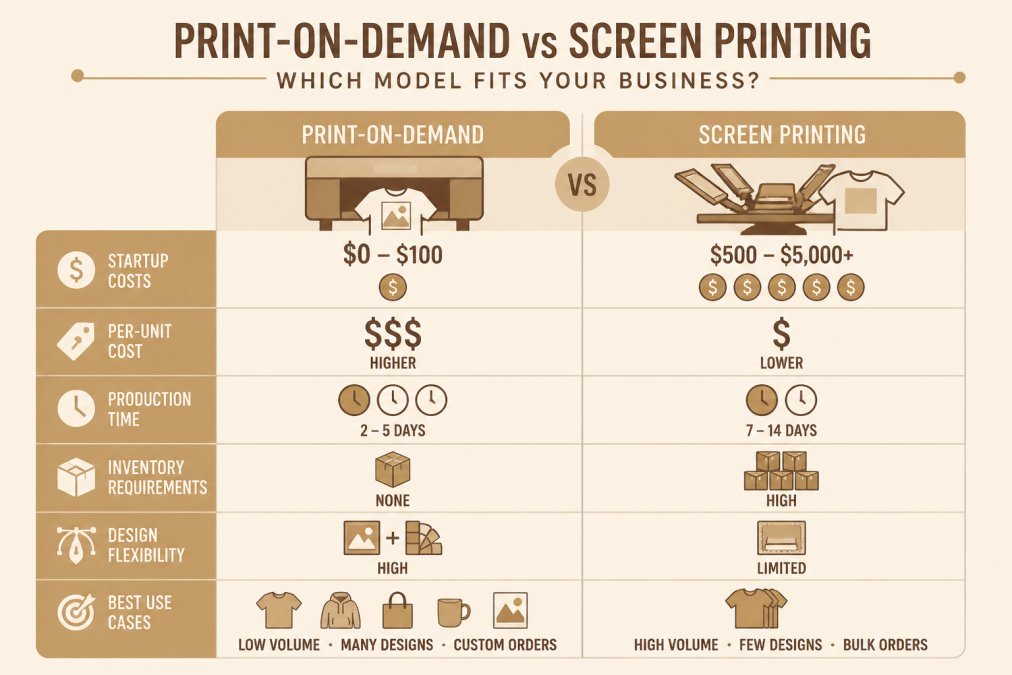
The process: you upload your design to a print provider's platform, set your price, and share the product link. When someone buys it, the provider prints your design onto a blank garment using direct-to-garment (DTG) printing, quality-checks it, and ships it to the customer. You never touch inventory or guess wrong on sizes or colors, the provider handles fulfillment entirely.
This model flips traditional retail on its head: instead of "design, produce 500 units, hope they sell," it's "design, sell one, produce one." That simplicity unlocks real advantages for creators, entrepreneurs, and small businesses launching without typical startup friction.
1. Start With Zero Inventory and Minimal Startup Costs
Most articles about print on demand stop at "it's cheap to start." That's true, but it hides what actually matters to a clothing brand: what you keep per sale. The startup advantage only pays off if the unit economics work, so it's worth walking through both.
The startup side
Traditional apparel manufacturing requires bulk orders, often 100+ units per design, upfront payment, and weeks or months of lead time. Print on demand removes that barrier: no minimum order, no deposit, no warehouse. You pay only when a customer buys, and many creators launch with just a design, a free provider account, and a link to share.
You can test a design for essentially nothing: if it flops, you've lost design time; if it sells, you scale without holding stock.
The unit-economics side (what most guides skip)
Here's what competitors rarely show: your profit per shirt is what's left after several costs stack up.
- Base garment cost, the blank tee itself, which varies by fabric weight and brand.
- Printing cost, DTG or screen printing, often bundled into the provider's base price.
- Platform fees, your storefront or marketplace takes a cut, commonly in the range of a few percent plus a small fixed fee per transaction.
- Shipping, either passed to the customer or absorbed into your price.
- Discounts and promotions, every sale code or seasonal markdown comes straight out of your margin.
A common pattern: you set a retail price, the provider charges a base cost that already includes the garment and print, your platform takes its fee, and what remains is your profit. Apply a 20% off code and that margin can shrink by several dollars.
This is why print on demand works best for designs with perceived value, niche artwork, personalization, or a strong brand story, rather than commodity basics competing on price. The model removes the capital barrier; your pricing discipline determines profitability.
2. Eliminate Inventory Risk and Unsold Stock
Unsold inventory is the silent killer of small apparel businesses. A creator produces 200 black tees in size medium, and suddenly they're sitting in a closet or storage unit for months, tying up money and space. Print on demand erases that problem.
With print on demand, you never buy inventory you can't sell. Every shirt is made to order. If zero people buy your design, you've lost only design time; if 500 do, the provider scales production without you managing a single unit.
This flexibility means you can experiment constantly, test niche designs, iterate on graphics, try seasonal or limited editions, because there's no financial penalty for a design that doesn't stick. Your only cost is design time and marketing effort, not manufacturing gambles.
For businesses like ours, this means keeping the entire catalog live indefinitely. Old designs don't become deadweight; they sit available, costing nothing until an order comes in.
3. Unlimited Creative Freedom and Product Customization
Print on demand apparel removes traditional manufacturing constraints. You're not locked into bulk color palettes, size ranges, or production minimums, you design it exactly how you want it, and it gets made.
Want your design in multiple colors or sizes S to 3XL? Most print providers support that. You control the design, placement, product type, and variations without negotiating with manufacturers or hitting minimums.
This creative freedom is especially valuable for niche brands. At Mild Statement LLC, we design for specific audiences: plant parents, bookworms, cat lovers, outdoor wanderers, introverts, coffee drinkers. Print on demand lets us create designs that speak directly to those communities without worrying about selling 500 units, if a design resonates, perfect; if not, we move on.
Customization extends to product type too. You're not limited to basic tees, providers offer hoodies, sweatshirts, hats, tote bags, and more. Test which products your audience wants before committing to bulk production.
Print-on-Demand Clothing Quality: Fabric, Print Method, and Durability
Quality is where print on demand gets scrutinized, and rightfully so. Since you're not managing production directly, the provider's choices matter enormously.
Most reputable print providers use quality blanks. Mild Statement tees, for example, are printed on Gildan Softstyle, premium ringspun cotton that stays soft wash after wash.
The print method also affects quality. Direct-to-garment (DTG) printing bonds ink directly to the fabric, creating prints that don't crack or peel and feel softer than screen-printed alternatives. DTG handles detailed artwork and gradients beautifully.
The reality: quality print on demand apparel is genuinely good. It's not cheap fast fashion or warehouse inventory sitting for months, it's made fresh, printed to your spec, and shipped directly. Durability depends on the provider and the wearer's care.
The trade-off is cost. Because each unit is made individually, the per-unit price is higher than bulk manufacturing. But you're paying for customization, freshness, and zero waste, not just fabric and labor.
4. Print-on-Demand Sustainability: Making Apparel Without Waste
The fashion industry generates enormous waste. Overproduction, unsold inventory, and fast-fashion cycles create mountains of textile waste every year. Print on demand disrupts part of that model, and it's worth being precise about which parts it doesn't solve.
Take the Scenic Route Graphic Tee – Outdoorsy Road Trip Unisex T-Shirt →
What print on demand genuinely improves
Because apparel is made only when ordered, there's no overproduction. No excess inventory sitting in warehouses or heading to landfills. No brand producing 500 units hoping 400 sell. One order, one shirt. That's a real reduction in waste compared to the traditional model, where unsold stock is a built-in cost of doing business.
It also shortens the supply chain: items go from the print provider directly to the customer rather than through multiple distribution centers, cutting intermediate warehousing and handling.
The trade-offs most articles ignore
Sustainability claims deserve scrutiny, and print on demand has real limitations:
- Packaging per unit. Shipping individual orders uses more packaging per shirt than bulk shipments to a retail store. Poly mailers and boxes add up.
- Shipping distance. If your provider prints in one region and the customer is far away, the shipping footprint per item can be higher than a locally stocked product.
- Production inputs. DTG printing uses water and inks, and garment production itself has an environmental cost regardless of when it happens.
- No universal standard. "Sustainable" isn't a regulated label here. Claims vary by provider, fabric, and print method, so it's worth checking what a specific provider actually does rather than assuming.
How to evaluate a provider's environmental story
If sustainability matters to you or your customers, ask concrete questions: Where are garments printed relative to customers? What packaging is used, and is it recyclable? What fabric is the blank, and how is it sourced? Providers that answer clearly are easier to trust than ones relying on vague green language.
The bottom line: print on demand is generally a lower-waste model than traditional apparel manufacturing, mainly because it eliminates unsold inventory. But it's not automatically sustainable, and the strongest position is transparency about both the wins and the trade-offs.
5. Scale Your Business Without Managing Fulfillment
One of the biggest operational headaches of growing an apparel business is fulfillment. As orders increase, you're managing inventory, packing boxes, coordinating shipping, handling returns. It becomes a logistics nightmare.
Print on demand eliminates that entirely. The provider handles production, quality control, packing, and shipping, while you focus on design and marketing.
This scalability is huge. If your tee goes viral and you get 1,000 orders in a week, you don't scramble for warehouse space or hire packers, the provider scales production automatically.
This is especially valuable for solo creators or small teams. You can run a multi-product apparel business from a laptop without touching inventory, no logistics staff, warehouse costs, or shipping carriers to coordinate.
As you grow, this model keeps overhead low. Traditional apparel businesses see costs spike with volume, more staff, more space, more complexity.
Print-on-Demand Shipping Time: Speed and Delivery Expectations
One legitimate concern with print on demand is shipping speed. Since items are made after purchase, delivery takes longer than buying from a warehouse stocked with pre-made inventory.
Typical print on demand shipping timelines are 2-5 business days for production, then 3-8 days for delivery, roughly 5-13 days total from order to doorstep.
Traditional retail fulfills from existing inventory, so delivery is faster (often 1-3 days).
At Mild Statement LLC, every tee ships in 2-5 business days after order, then arrives in 3-8 days.
For gift-givers, this timeline is worth planning around. A birthday gift next month works fine; a shirt needed in three days won't.
Print on demand clothing offers genuine advantages for creators, entrepreneurs, and conscious consumers: zero startup costs, no inventory risk, unlimited creative freedom, sustainable production, and scalable operations without the logistics headache.
If you're testing an apparel idea, launching a niche brand, or looking to support independent makers, print on demand is the most accessible model available. Every tee, from our Take the Scenic Route Graphic Tee for wanderers to our Slow Mornings Club Graphic Tee for hikers and campers, is printed on demand in premium Gildan Softstyle cotton with direct-to-garment printing.


Frequently Asked Questions
What are the main benefits of print on demand clothing for new entrepreneurs?
Print on demand clothing removes the biggest barriers to launching an apparel business: you need no upfront inventory investment, no warehouse space, and no risk of unsold stock. You design once, customers order, and products print and ship on demand. This means you can start with just a few designs and scale based on actual customer demand, not guesswork. Mild Statement designs are printed directly onto Gildan Softstyle tees using direct-to-garment (DTG) printing, so every shirt ships within 2-5 business days after printing.
How does print-on-demand clothing quality compare to bulk screen-printed apparel?
Print-on-demand clothing quality depends on the supplier and print method. Direct-to-garment (DTG) printing, used by Mild Statement, bonds ink directly into fabric fibers, creating durable, soft prints that improve with washing. Gildan Softstyle tees use 100% ring-spun cotton (4.5 oz/yd² weight) that stays soft through repeated wear and washing. The main trade-off: DTG is ideal for small runs and complex designs.
Is print-on-demand clothing more sustainable than traditional manufacturing?
Print-on-demand eliminates overproduction waste, the biggest sustainability problem in apparel. With traditional manufacturing, brands produce hundreds or thousands of units hoping to sell them, leading to excess inventory that ends up in landfills. Print-on-demand produces only what customers actually order, so nothing goes to waste. However, shipping individual orders uses more packaging and transport per unit than bulk shipments. The net environmental benefit depends on how you weigh overproduction waste against increased shipping impact. Mild Statement prioritizes this trade-off by offering free shipping on every order, keeping the model accessible.
How long does print-on-demand shipping time actually take?
Print-on-demand shipping time typically includes two phases: production (2-5 business days) plus transit (3-8 days). Mild Statement ships all orders within 2-5 business days after printing, then standard delivery takes 3-8 days, so total time is roughly 5-13 business days. This is slower than buying off-the-shelf apparel but faster than traditional bulk manufacturing, which requires weeks of production before shipping begins. For gift-giving or time-sensitive orders, plan ahead and confirm production timelines before ordering.
Can I actually make a profit selling print-on-demand clothing?
Yes, but margins are tighter than bulk production. The advantage is volume: you can sell 100 shirts profitably without holding a single unit in inventory. Success depends on finding your audience and building repeat customers, print-on-demand rewards creators with strong design and marketing, not those betting on bulk inventory discounts.