 Ultimate guide
How to Buy Ethical Graphic Tees: 2026 Buyer's Guide
Table of Contents
- What Makes a Graphic Tee Ethical?
- Sustainable Clothing Certifications That Actually Mean Something
- How to Check Clothing Brand Ethics Before You Buy
- Print-on-Demand T-Shirts Sustainability: What the Model Gets Right
- Fabric, Printing, and Durability: What to Compare on the Label
- Artwork Rights and Artist Compensation on Graphic Tees
- A Step-by-Step Checklist for Buying Ethical Graphic Tees
- Conclusion
- Frequently Asked Questions
Last Updated: October 18, 2026
What Makes a Graphic Tee Ethical?
Most people think an ethical tee is simply one made from organic cotton. That's only a third of the story.
An ethical graphic tee uses verified low-impact materials, transparent labor practices, and artwork that compensates its creator fairly.
A shirt can be organic and still hide a murky supply chain, or ethically sewn and printed with plastisol ink that never breaks down.
This guide shows how to buy ethical graphic tees by verifying each layer yourself instead of trusting a marketing page.
Sustainable Clothing Certifications That Actually Mean Something
Sustainable clothing certifications are third-party audits that verify a specific claim, organic fiber content, harmful substance limits, recycled content, or fair labor, rather than a brand's overall virtue. A certification covers one link in the chain, not the whole shirt.
Here's what each covers, and what it doesn't.
- GOTS (Global Organic Textile Standard): Covers organic fiber content plus processing and social criteria across the supply chain. It touches both environmental and labor questions, but applies only to the certified facility and product, not every style a brand sells.
- OEKO-TEX Standard 100: Tests finished fabric and garments for harmful substances. It says nothing about organic fiber, worker conditions, or printing, a shirt can pass and still come from a factory with poor labor practices.
- Fair Trade Certified: Focuses on worker premiums and conditions at certified facilities. It does not verify fiber content or environmental impact.
How to actually verify a certification
A logo means nothing unless you can trace it. The step most shoppers skip is matching the certificate to the exact garment.
- Find the certificate or license number. It's usually on the hangtag, care label, or product page, not just in a brand's general sustainability section.
- Check the certifying body's public database. The Global Organic Textile Standard official site and the OEKO-TEX label check both let you search by certificate number or company name. If a brand cannot point you to a searchable record, treat the claim as unverified.
- Confirm the product scope. Certificates list the specific products or facilities covered. A brand may be certified for one fabric or style and show the logo across an entire collection.
- Check the date. Certificates expire and are renewed annually. An expired certificate is not proof of current practice.
What common claims do not prove
Several phrases sound like certifications but carry no third-party verification:
- "Eco-friendly," "green," "conscious," and "sustainable" are marketing terms with no legal definition here. They require no audit, standard, or disclosure.
- "Made with organic cotton" does not mean the finished garment is certified organic. Fiber can be grown organically and processed in an uncertified facility, which is why GOTS covers processing as well as farming.
- "Recycled" without a standard behind it can mean pre-consumer factory scraps rather than post-consumer waste, and says nothing about labor or chemical use in recycling.
A useful rule: if a claim names a certifying body and a certificate number you can look up, it's verifiable. If it names a feeling, it's decoration.
The certification stack that actually tells a full story
No single certification covers fiber, processing, chemistry, labor, and printing at once. A brand that can show a stack, GOTS for fiber and processing, OEKO-TEX for harmful substances, and a published factory list for labor, gives you far more than one logo. Count verified links in the chain, not badges on the page.
How to Check Clothing Brand Ethics Before You Buy
Start with the "About" and "Sustainability" pages, then look for a supplier list or factory disclosure.
For print-on-demand brands, ask who fulfills the order. Many use domestic production partners, which shortens shipping distance and keeps more of the process visible.
A quick gut check: does the brand explain its choices in plain language, or hide behind the word "conscious"? Vague language is a signal, not a selling point.
Print-on-Demand T-Shirts Sustainability: What the Model Gets Right
Print-on-demand T-shirts sustainability is real but partial. The model's genuine strength is waste reduction: a shirt is printed only after someone orders it, so there's no unsold inventory headed for a landfill. That matters because overproduction is one of apparel's biggest environmental problems, the U.S.
But "no deadstock" is one box, not a full scorecard. A POD shirt is only as green as its blank, its ink, and the distance it travels.
The printing method matters more than the model
Print-on-demand is a production model, not an ink choice. The same POD workflow can use very different printing technologies:
- Water-based inks (including DTG with water-based ink): The pigment bonds with the fabric rather than sitting on top of it. The print stays soft and breathable, and the ink chemistry avoids the plastisol plasticizers that make prints stiff. Water-based prints can fade faster on high-wear areas, so durability depends on the blank and the cure.
- Plastisol inks: The industry standard for screen printing. Durable and colorfast, but plastisol is a PVC-based ink that sits on top of the fabric, feels stiffer, and does not biodegrade readily. It is also the harder ink to manage at end of life, especially on blended fabrics.
- DTG (direct-to-garment) with water-based ink: Common in POD because it needs no screens and handles small runs. Print quality depends heavily on the blank, 100% cotton takes DTG well, while high-polyester blends can produce a duller, less durable print.
A practical rule: ask what ink and what method, not just whether the shirt is print-on-demand. Water-based DTG on an organic cotton blank is genuinely lower-impact; plastisol on a polyester blend is not, no matter how the order was fulfilled.
Where the model falls short
Three trade-offs deserve honesty:
- Material is unchanged. POD does not make the blank better. If the base tee is conventional cotton or virgin polyester, the fiber impact is the same as a mass-produced shirt.
- Shipping is per-order. Because each shirt ships individually rather than in bulk, packaging and last-mile distance can add up. Domestic fulfillment partners shorten that distance, which is one reason to ask who fulfills the order.
- Print durability affects lifespan. A print that cracks or fades after a few washes shortens the shirt's useful life, which undercuts the waste savings. Water-based prints on a well-made cotton blank tend to hold up; cheap plastisol on a thin blend often does not.
We print on demand because it eliminates deadstock, and we'd rather be honest that it doesn't solve everything. Pair it with a responsibly sourced blank and water-based ink and you've got a genuinely lower-impact shirt; skip those and "no waste" is the only box it checks.
End-of-life is the part nobody plans for
Printed garments are harder to recycle than plain ones, and blended fabrics harder still. A few options:
- Repair first. A cracked print can sometimes be re-printed or covered; a torn seam can be mended. Repair keeps the garment in use, which beats recycling.
- Resale or donation extends the life of a wearable tee, though printed logos limit resale appeal.
- Textile recycling accepts some natural-fiber garments, but blended fabrics and plastisol prints complicate the process. Check whether a local program accepts printed tees before assuming they will be recycled.
When you compare POD tees, score them on the blank, the ink, the print durability, and the end-of-life plan, not just the fulfillment model.
Fabric, Printing, and Durability: What to Compare on the Label
Fabric and printing decide whether a tee lasts one summer or five. On the label, look for a named fiber, a printing method, and care instructions. Vague fiber descriptions are a red flag.
Here's how the common options stack up:
| What to Check | Better Choice | Why It Matters |
|---|---|---|
| Fiber | Organic cotton, recycled fibers | Lower pesticide and water impact |
| Ink | Water-based ink | Softer hand-feel, fewer harsh solvents |
| Print method | Screen or DTG with water-based ink | Better durability, cleaner breakdown |
| Construction | Reinforced neck and seams | Survives repeated washing |
| Care | Cold wash, line dry | Extends garment lifespan |
Durability is the quiet sustainability win: a shirt you wear for years replaces a dozen cheap ones. Feel for substantial fabric weight and check whether the neck seam is reinforced, because that's where cheap tees fail first.
Comfort is tied to fiber and print.
Artwork Rights and Artist Compensation on Graphic Tees
Original artwork is where ethical graphic tees get complicated, because the design is intellectual property.
Ask three questions:
- Who made this design, and is the artist credited?
- Is the artwork original or licensed, and are the rights clear?
- Does the brand's design process respect the creator's ownership?
A common mistake is assuming a cute design is original when it's a lifted image. Reputable brands can tell you where the art came from.
This is where "wearable art" earns its name: a shirt with a credited, original design carries value a copy never will, and it's one more way to tell an ethical brand from a fast one.
A Step-by-Step Checklist for Buying Ethical Graphic Tees
Use this checklist in order, and you'll compare shirts on facts instead of vibes. It takes about five minutes per brand.
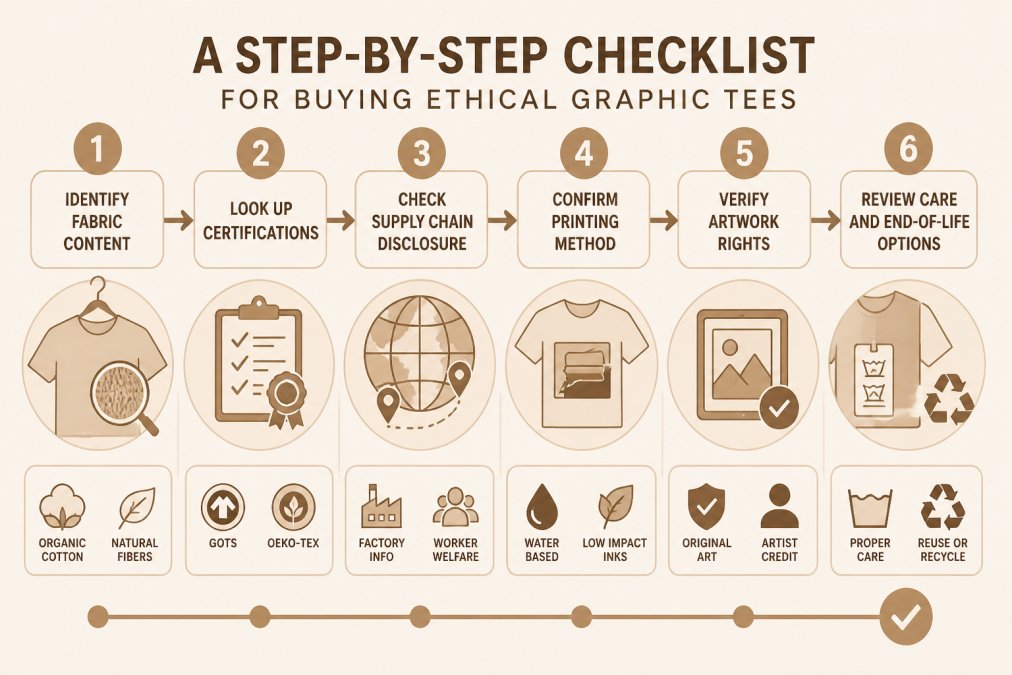
- Identify the fiber. Is it organic cotton, recycled polyester, or a named blend? Skip vague "cotton blend" claims.
- Verify certifications. Match the certificate to the exact garment, not the brand's general page.
- Check supply chain disclosure. Can you find where it's made and who fulfills it?
Sizing and fit transparency count too. A brand that publishes real measurements and a clear return policy respects your time, and that's part of buying responsibly.
Conclusion
The hard part of buying ethical graphic tees isn't finding claims, it's verifying them. Certifications, supply chain disclosure, printing method, and artwork rights each tell you one piece of the truth, and you have to check all four.
That's the standard we build to at Mild Statement.
Ready to put the checklist to work? Browse the collections at Mild Statement and find a tee that fits your personality, quietly.
Frequently Asked Questions
What makes a graphic tee ethical?
An ethical graphic tee combines four things: responsibly sourced fabric (organic cotton or recycled fibers), fair labor in cut-and-sew and printing, transparent disclosure of where it was made, and artwork that was licensed or created fairly. No single label proves all four. Look for specific certifications, a published supply chain, and a brand willing to answer direct questions about its factories and printing methods.
What sustainable clothing certifications should I look for?
The most useful sustainable clothing certifications cover different stages. For fiber, look for GOTS (organic cotton) or GRS (recycled content). For labor, SA8000 and Fair Trade Certified address worker conditions. Bluesign and OEKO-TEX cover chemical safety in textiles and printing. A brand citing one certification is better than none, but a brand that can name certifications across fiber, labor, and printing is showing real supply chain transparency.
Are print-on-demand T-shirts actually more sustainable?
Print-on-demand T-shirts sustainability comes mostly from waste reduction: nothing is printed until someone orders, so there is far less unsold inventory and deadstock than with traditional retail. That advantage is real but partial. The fabric and printing method still determine most of the environmental impact. A print-on-demand shirt made with organic cotton and water-based ink is a meaningfully better choice than a conventionally printed one made with plastisol ink.
How can I find out where a graphic tee was made?
Start with the label and the product page. Ethical brands typically name the country of cut and sew and often the printing facility. If that information is missing, email the brand and ask which factory sewed the shirt and where it was printed. A brand that answers clearly is demonstrating supply chain transparency. A brand that deflects or sends a generic sustainability page is telling you something too.
How do I choose a graphic tee that will last?
Check fabric weight and stitch quality. Heavier cotton knits resist thinning and hold their shape longer. Look at the collar: a ribbed collar with double stitching survives washes better than a thin single-stitch one. Printing method matters too, since water-based inks cure into the fabric and tend to crack less than thick plastisol layers. Follow care instructions, wash cold, and air dry to extend garment lifespan.
What questions should I ask a clothing brand about its supply chain?
Ask four questions: Which factory sewed this shirt, and where is it located? Which certifications does that factory hold? What printing method and ink do you use? Can you tell me who created the artwork and how they were compensated? Specific answers signal a brand that knows its supply chain. Vague answers about being eco-conscious without names, places, or certifications are a warning sign.